
Key takeaway
The highest-converting remarketing audiences for small businesses are past website visitors (especially service pages), email list subscribers, and video viewers — start with these before expanding to cold audiences.
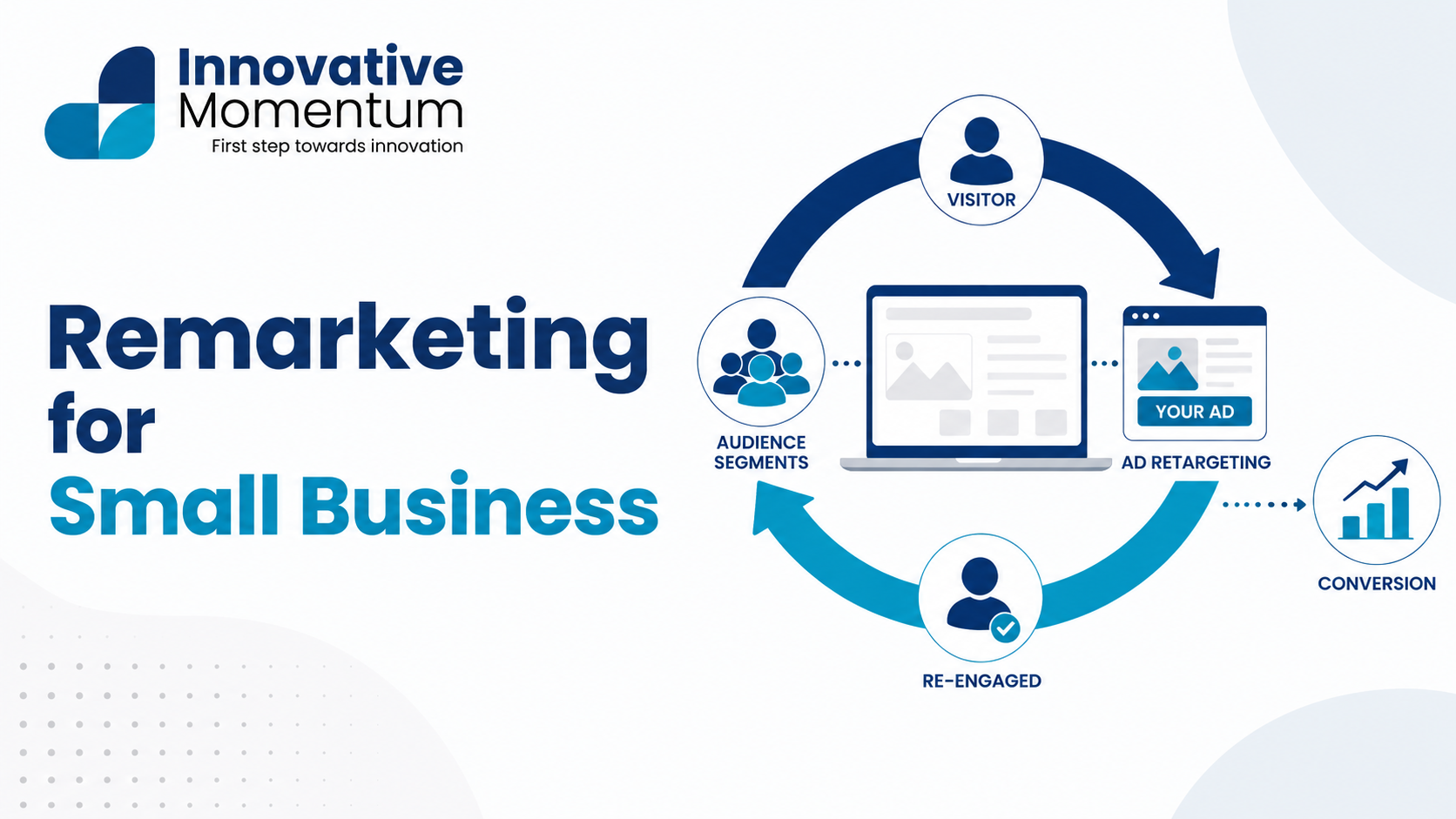
Remarketing is one of the highest-ROI digital advertising strategies available to small businesses because it targets people who have already expressed interest in your business. A visitor who viewed your service page, spent time on your website, or engaged with your content has already passed the hardest barrier — awareness. Remarketing campaigns reach these warm prospects with targeted messages designed to bring them back and convert them into clients. For small businesses with limited advertising budgets, remarketing delivers lower cost-per-lead and higher conversion rates than any cold audience campaign.
This guide covers how remarketing works, which platforms offer it, how to build effective remarketing audiences, and the ad creative and messaging strategies that convert warm prospects.
How Remarketing Works
Remarketing uses cookies and tracking pixels to identify visitors who have been to your website and then show them targeted ads on other platforms they subsequently visit. When someone visits your homepage, browses your service pages, or reads your blog but does not enquire, a remarketing tag drops a cookie in their browser. That cookie allows your ad platforms — Google, Meta, LinkedIn — to recognise that person when they visit other websites or open social media apps, and serve them an ad from your business.
The technical setup requires a tracking pixel on your website from each platform you intend to remarket through: the Google tag (formerly Google Analytics tag, now Google Tag Manager) for Google Display and YouTube remarketing, the Meta Pixel for Facebook and Instagram remarketing, and the LinkedIn Insight Tag for LinkedIn remarketing. Each pixel must be installed before you can build remarketing audiences — they need time to accumulate data. Our guide on technical SEO audits covers tracking tag implementation as part of the broader website technical setup.
Innovative Momentum
Want to implement these strategies for your business?
We help businesses grow with digital marketing, SEO, and AI-ready content strategies.
Building Effective Remarketing Audiences
Not all website visitors are equally valuable as remarketing targets. Segment your remarketing audiences by intent level:
High-intent audiences (highest priority)
- Service page visitors who did not contact: Visited one or more service pages but did not submit a form. These are the warmest non-converted prospects in your marketing system — they were close to enquiring and need a final push.
- Pricing page visitors: If your site has a pricing page, visitors who viewed it were actively evaluating whether they could afford you. Remarketing to this audience with a testimonial or a free consultation offer directly addresses the “is this worth it?” hesitation.
- Cart abandoners (e-commerce): Visitors who added items to a cart but did not complete purchase. This is the highest-intent remarketing audience in e-commerce with typical conversion rates 3-5x higher than cold audiences.
Medium-intent audiences
- Blog readers: Visitors who read one or more blog posts. They are in research mode but have not yet expressed service intent. Remarketing to blog readers with educational content (a guide, a webinar) moves them toward consideration.
- Homepage-only visitors: Visited the homepage but did not navigate further. May have found the homepage unclear or may have been comparison shopping. Remarketing with a specific, relevant service message can re-engage them.
- Video viewers: On YouTube and Facebook, people who watched 25-50%+ of your video content have demonstrated engagement. This audience often converts well because video viewers have spent more time with your content than page visitors.
Exclusion audiences
Exclude existing customers and recent enquirers from acquisition remarketing campaigns. Running ads to people who have already converted wastes budget and can be perceived as tone-deaf by clients who are paying you. Create a custom audience from your CRM email list and exclude it from all acquisition campaigns.
Remarketing on Google: Display and YouTube
Google Display Network remarketing shows banner ads across millions of websites to your tagged visitors as they browse the web. Google Display is the broadest-reach remarketing channel — your tagged visitors will see your ads across news sites, industry publications, and any website that carries Google Display advertising. The disadvantage is that Display ads have low click-through rates (typically 0.1-0.3%) because banner ads are often ignored.
YouTube remarketing shows video ads to visitors who watched your YouTube videos or visited your website. YouTube video ads can be skippable (TrueView In-Stream, where you pay only if the viewer watches at least 30 seconds) or non-skippable (15 second bumper ads). For small businesses, skippable TrueView ads are more cost-effective — you only pay for engaged viewers, and the 5-second hook before the skip button appears is an opportunity to immediately qualify viewer interest.
Google Performance Max (PMax) campaigns automatically run across Google Search, Display, YouTube, Gmail, and Discover simultaneously with machine-learning allocation. PMax with a remarketing audience list signal is one of the most efficient Google remarketing options for small businesses with limited management time, though it provides less granular control than individual campaign types.
Remarketing on Facebook and Instagram
Meta’s remarketing capabilities are built on the Meta Pixel installed on your website. Facebook and Instagram remarketing audiences are defined in Meta’s Events Manager and then applied to ad sets targeting those specific audiences. The highest-performing remarketing creative formats on Meta for service businesses:
- Social proof ads: Testimonials, case studies, or review screenshots. These address the trust gap that prevents warm prospects from converting.
- Specific service reminder: If the visitor viewed a specific service page, serve them an ad about that specific service. Dynamic ads on Meta can automatically personalise the ad content based on which page the visitor viewed.
- Limited availability or incentive: A time-limited offer (free consultation this month, booking window closing) creates urgency without being manipulative. Use only if the offer is genuine.
Remarketing Budget and Frequency Capping
Remarketing audiences are smaller than cold audiences — they are limited to the number of people who have visited your website in a given time window. Small business websites with under 1,000 monthly visitors will have small remarketing pools, which means remarketing campaigns can exhaust their audience quickly and individual visitors may see the same ad many times. Frequency capping limits how many times the same person sees your ads per day or week and prevents ad fatigue.
Recommended frequency caps for remarketing: maximum 3-5 impressions per day on Google Display, maximum 2-3 per day on Meta. Above these thresholds, ad fatigue typically drives negative sentiment rather than conversions. Rotate 2-3 creative variants to reduce repetition even within the frequency cap. For the broader paid advertising strategy, our guide on digital marketing strategy for small businesses covers how remarketing fits within the full paid and organic channel mix.
Measuring Remarketing Campaign Performance
Remarketing attribution requires awareness of the attribution window. Google Ads default conversion window is 30 days; Meta Ads default is 7-day click and 1-day view. A visitor who saw your remarketing ad but converted 15 days later may be attributed to the remarketing campaign under Google’s 30-day window but not under Meta’s 7-day window — which is why cross-platform attribution reports in GA4 provide a more complete picture than platform-native reports alone.
Key metrics for remarketing campaigns: cost per conversion (lower than cold audience campaigns confirms the remarketing premium is justified), conversion rate (the percentage of remarketing ad clicks that convert), and ROAS (for e-commerce). Track these separately from cold audience campaign metrics — blending them produces misleading averages that make cold campaigns look worse and remarketing campaigns look like the only thing working.
Remarketing Audience Segmentation Strategy
The most effective remarketing campaigns do not treat all website visitors identically. Segmenting your remarketing audiences by the intent signal their visit behaviour represents allows you to show more relevant ads and makes your budget work harder by prioritising the highest-intent segments.
Audience segmentation framework for small business remarketing:
- High intent — pricing page visitors: Visitors who viewed your pricing page have demonstrated explicit purchase consideration. This audience deserves the highest bid multiplier and the most direct, conversion-focused ad creative. Ad message: address the most common objections or questions that would prevent conversion from this consideration stage.
- High intent — contact page visitors who did not submit: Visitors who reached the contact page but did not submit a form are the closest to converting of any audience segment. Show them a direct ad with a strong, specific reason to return and complete the contact (a deadline, a specific offer, or a compelling testimonial from a similar client).
- Medium intent — service page visitors: Visitors who viewed a specific service page are interested in that service but have not reached the decision stage. Show them content that moves them further down the consideration path: case studies relevant to that service, client testimonials, or a specific free consultation offer.
- Low intent — blog readers: Blog readers are in the awareness stage. Direct sales messages rarely convert this audience. Show them content offers (guides, checklists, or free resources) that capture their email address, moving them into a lower-cost email nurture sequence rather than the more expensive paid remarketing cycle.
- Customer retention: Existing customers can be retargeted with cross-sell or upsell offers, renewal reminders, or content that deepens their engagement with your business. This audience converts at significantly higher rates than new prospect remarketing and is often overlooked.
Setting Up Google Analytics 4 Audiences for Remarketing
Google Analytics 4 (GA4) is the primary audience source for Google Ads remarketing. GA4 allows you to create custom audiences based on page views, events, session duration, and any other interaction data collected on your site. Creating remarketing audiences in GA4:
- In GA4, navigate to Configure → Audiences → New Audience
- Build audiences using conditions: “Page path contains /pricing” for pricing page visitors, “Page path contains /contact” for contact page visitors, “Session duration greater than 60 seconds” for engaged visitors
- Set the audience membership duration (how long a visitor stays in the audience after meeting the criteria). Typical durations: high-intent audiences 7-14 days, medium-intent 30 days, blog readers 60-90 days
- Link the audience to Google Ads via the Admin → Google Ads Links setting in GA4
- The audience becomes available in Google Ads for campaign targeting once it reaches 100 members for Display or 1,000 for Search
Our guide on digital marketing strategy covers how remarketing integrates with new visitor acquisition campaigns in a full-funnel paid media approach.
Remarketing Frequency and Ad Fatigue Management
One of the most common remarketing mistakes is showing ads to the same visitor too frequently over too short a period. A prospect who has visited your pricing page once and then sees your ad 15 times in the following week does not experience this as helpful reminder marketing — it reads as surveillance and generates negative brand associations. Frequency capping — limiting how many times a specific visitor sees your ads within a given period — is the solution. For Google Display remarketing, a frequency cap of 3-5 impressions per day per user is the starting point; most small businesses can reduce this to 2-3 per day without meaningful loss of conversion volume. For Facebook and Instagram remarketing, Meta’s frequency management is less granular but campaign budget size relative to audience size implicitly controls frequency — a small daily budget against a very small custom audience will naturally reach high frequency, which is a sign to expand the audience or reduce the budget.
Rotate ad creative every 2-3 weeks for high-frequency remarketing campaigns. Visitors who are in a longer consideration cycle (comparing multiple providers over several weeks) will see your ads repeatedly. Showing the same ad for weeks produces declining engagement and increasing negative sentiment. A rotation of 3-4 creative variants — each addressing a different benefit, objection, or social proof element — sustains message exposure without the fatigue that a single static ad generates. Our guide on Google Search Console covers how to identify the pages that generate the highest-quality traffic, making them the natural first choice for remarketing audience definition.
Frequently Asked Questions
How much traffic do I need before remarketing is worth setting up?
Google requires a minimum of 1,000 users in a remarketing list before Display ads can run. Meta’s minimum is 100 users for a Custom Audience. In practice, remarketing campaigns need at least 500-1,000 qualified visitors per month to generate sufficient audience size for consistent ad delivery. If your website receives fewer than 500 visitors per month, invest first in increasing traffic through SEO and content marketing, then add remarketing when the audience is large enough to be meaningful.
Is remarketing too expensive for a small business?
Remarketing is typically the most cost-efficient advertising spend in a small business’s paid media budget precisely because the audience is warm. Cost per conversion for remarketing is usually 30-60% lower than cold audience campaigns for the same business. The absolute budget required is modest — remarketing to small website audiences can be effective at £100-300/month — because the audience is small and the CPMs are lower than cold audience targeting.
Does remarketing feel creepy to website visitors?
Research consistently shows that consumers are more receptive to ads from businesses they’ve already expressed interest in than from businesses they’ve never heard of. The “creepy” perception arises from overly aggressive frequency (seeing the same ad 20 times in a day) or from contextually inappropriate placements. Frequency-capped, well-creatively-executed remarketing from a relevant business does not generate negative sentiment at the rates that marketers fear. For help setting up remarketing campaigns for your business, contact Innovative Momentum.

Keep reading
Related insights
No comments yet. Be the first to share your thoughts.