
Key takeaway
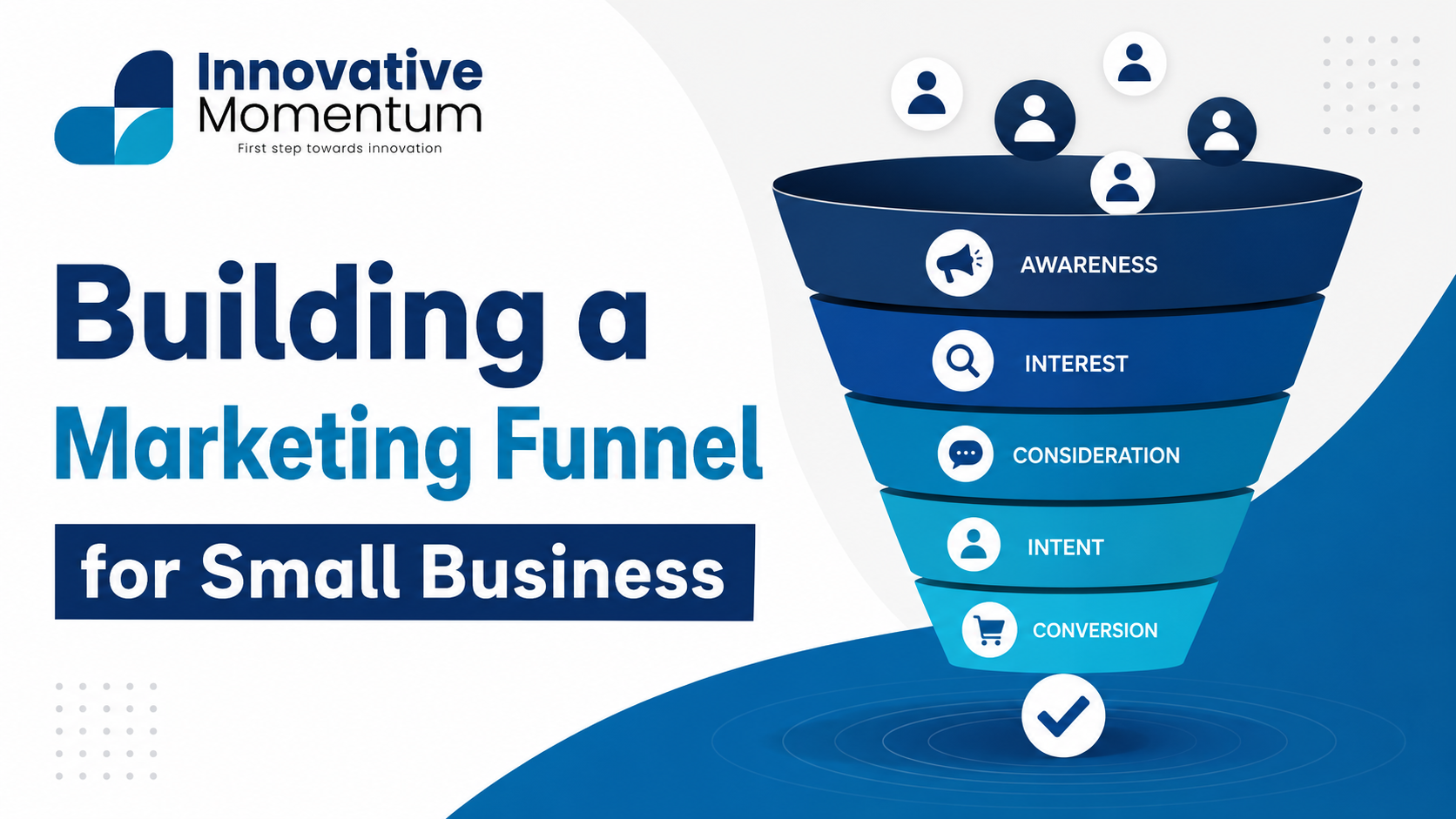
A simple small business marketing funnel has three stages: attract (SEO, social, ads), nurture (email, retargeting, content), and convert (landing pages, offers, calls) — focus on one stage at a time, starting with attract.
A marketing funnel is the structured journey a potential customer takes from first becoming aware of your business to becoming a paying client. Without a deliberately designed funnel, most small businesses lose potential clients at every stage of that journey — through weak awareness, unclear positioning, or an absence of follow-up that lets warm prospects drift to competitors. Building a marketing funnel is not about using complex technology or running expensive campaigns; it is about understanding the decision stages your prospects go through and having intentional marketing activity at each stage.
This guide covers how to build a marketing funnel for small businesses in 2026, from first awareness through to conversion and retention, using the tools and channels accessible to businesses with realistic budgets.
The Four Stages of a Small Business Marketing Funnel
Marketing funnels are sometimes overcomplicated with multiple sub-stages and jargon. For small businesses, four stages capture the essential journey:
Stage 1: Awareness
The prospect becomes aware your business exists. They may have found you via a Google search, a social media post, a recommendation, or an ad. At this stage they have a problem and are discovering who might solve it. Your marketing goal at Awareness: be discoverable in the places they are looking, with messaging that confirms you understand their problem.
Innovative Momentum
Want to implement these strategies for your business?
We help businesses grow with digital marketing, SEO, and AI-ready content strategies.
Stage 2: Consideration
The prospect is actively evaluating options and deciding which business to trust with their problem. They may visit multiple websites, read reviews, watch videos, and compare pricing. At this stage your marketing goal is to build credibility, demonstrate expertise, and reduce the perceived risk of choosing you over alternatives.
Stage 3: Conversion
The prospect makes contact or completes a purchase. For service businesses this is typically a form submission, phone call, or booking. At this stage your marketing goal is to make the conversion action as frictionless as possible and to ensure your offer is clearly communicated.
Stage 4: Retention and Advocacy
The client has bought and continues the relationship. Existing clients are the most profitable source of revenue for most service businesses — through repeat purchase, upsell, and referral. At this stage your marketing goal is to deliver an experience worth talking about and to create systematic referral and review-generation processes.
Building the Awareness Layer
Awareness for small businesses is built through a combination of organic and paid channels, depending on budget and timeline requirements. The most durable awareness channels:
- Search engine optimisation: Ranking on page 1 of Google for queries your target clients use is the highest-value awareness channel for most service businesses. Organic traffic compounds over time and does not stop when a budget runs out. Our guide on SEO for service businesses covers the specific optimisation approach for service-sector businesses.
- Content marketing: Blog posts, guides, and videos that answer the questions your prospects are asking during their research phase. Content creates awareness at the moment of highest intent — when the prospect is actively seeking information. Our guide on content marketing for small businesses covers the strategy that drives awareness through content.
- Google Business Profile: For local service businesses, Google Business Profile optimisation generates awareness in local search results and Google Maps. Our guide on Google Business Profile optimisation covers the full setup and management approach.
- Paid advertising: Google Ads for search intent, Facebook and LinkedIn Ads for interest and demographic targeting. Paid ads generate immediate awareness but require ongoing budget to sustain. Best used to accelerate awareness while organic channels build.
Building the Consideration Layer
Once a prospect is aware of your business, the consideration stage is where most small businesses lose potential clients. The prospect visits your website, finds it unconvincing or unclear, and moves on to a competitor. The consideration layer requires specific assets and content that build the confidence needed to make contact:
- Case studies and client results: Specific, named (or clearly anonymised) examples of client problems solved and outcomes achieved. Generic claims (“we deliver results”) are unconvincing; specific results (“we increased organic leads for a Manchester plumber by 340% in 9 months”) are compelling.
- Reviews and testimonials: Social proof from real clients. The minimum viable review presence for a competitive local service business is 20+ Google reviews with an average above 4.5 stars. Our guide on getting more Google reviews covers the systematic approach to building review volume.
- Educational content: Blog posts and guides that demonstrate expertise in your field. A prospect who has read three blog posts from you before making contact has significantly more trust than one who found you via a single ad click.
- Lead magnets: A free resource (guide, checklist, tool) that captures email addresses in exchange for value. This moves prospects from website visitors to email subscribers, where you can continue the relationship over time even if they do not convert immediately.
Email Nurture: Connecting Awareness to Conversion
Most first-time website visitors are not ready to buy. They may be early in their research, uncertain about timing, or comparing multiple options. Email nurture is the system that maintains the relationship with these prospects over the weeks and months between their first visit and when they are ready to buy.
A basic email nurture sequence for small service businesses:
- Welcome email (immediate): Deliver the lead magnet promised on the opt-in form. Set the expectation for future emails — what they will receive and why it is valuable.
- Value email 1 (day 3): Share a genuinely useful piece of content related to the problem your service solves. No pitch.
- Value email 2 (day 7): A client result or brief case study. Begin the credibility-building process.
- Soft introduction (day 14): Introduce your service briefly, focused on the problem it solves. Include a low-friction CTA (book a free call, not “buy now”).
- Ongoing (weekly or fortnightly): Educational content mixed with occasional service reminders. The ratio should be approximately 4:1 value-to-pitch.
Conversion: Reducing Friction at the Decision Point
The conversion stage is where the technical and copy quality of your website has the most impact. Common conversion blockers on small business websites:
- Unclear next steps: The visitor does not know what to do to begin. Have one primary CTA on each page that tells them exactly what happens next.
- Long or complex forms: Every additional field on a contact form reduces completion rate. Collect only what you need to qualify the enquiry (name, email, brief description of need). Collect other information in the discovery call.
- No trust signals near the CTA: Place a testimonial, review count, or specific result near your primary contact form. People hesitate at the moment of commitment — a trust signal at that exact point reduces hesitation.
- Slow load time: Visitors who wait more than 3 seconds for a page to load bounce at higher rates. Our guide on website speed optimisation covers the technical improvements that reduce load time.
Retention and Advocacy: The Most Profitable Funnel Stage
Existing clients are the most profitable segment in any service business’s marketing funnel. They have already paid the client acquisition cost, they require less persuasion to buy again, and they are the most likely source of referrals. Building systematic retention and advocacy marketing produces compounding returns that acquisition-only marketing cannot match.
Practical retention and advocacy tactics: quarterly client check-ins to ensure satisfaction and surface upsell opportunities, a systematic review request process triggered after successful project completion, a referral programme that incentivises clients to introduce their network, and an ongoing email newsletter that keeps you top-of-mind for repeat and referral business. For the measurement framework that tracks funnel performance, our guide on Google Search Console for small businesses covers how to monitor organic search performance at the top of your funnel.
Email Marketing in the Marketing Funnel
Email is the highest-converting channel in most small business marketing funnels because it reaches an audience that has already expressed interest by subscribing. While social media and paid advertising reach cold audiences at scale, email reaches warm audiences who have opted in to hear from you — a fundamentally different and more conversion-ready starting position.
Email’s role in the funnel by stage:
- Awareness to Consideration (lead magnet sequences): A prospect downloads a free guide, checklist, or resource and enters an automated welcome sequence. The sequence delivers the promised value, establishes your expertise with 3-5 educational emails, and introduces your paid services after trust has been established. This transition from free value to commercial offer performs better than leading with a sales pitch.
- Consideration to Decision (case study and social proof emails): Subscribers in the evaluation stage respond to specific evidence: case studies with results, testimonials, and before/after comparisons. A 3-5 email case study sequence presented as a narrative — problem, approach, result — is particularly effective for high-value service businesses where the purchase involves significant trust.
- Post-purchase retention: Email is the primary channel for onboarding new clients, delivering ongoing value between service interactions, and generating referrals. Clients who receive regular, valuable communication after the sale have higher lifetime value and are more likely to refer. Our guide on digital marketing strategy covers how email integrates with the other channels in a cohesive growth system.
Marketing Funnel Metrics and How to Read Them
Understanding which metrics matter at each funnel stage prevents the common mistake of optimising for top-of-funnel volume (more website visitors) when the conversion problem is actually at the bottom of the funnel (visitors are not converting to leads or leads are not converting to clients).
Funnel stage metrics:
- Awareness stage: Organic search impressions (Google Search Console), social media reach, website unique visitors. Rising metrics here indicate growing visibility. If awareness metrics are growing but conversions are not, the problem is in the mid-funnel or bottom-funnel stages, not awareness.
- Consideration stage: Pages per session, average session duration, blog post engagement, email list growth rate. These indicate whether visitors are engaging with your content rather than bouncing immediately after arrival.
- Decision stage: Contact form submission rate, consultation booking rate, quote request rate. The conversion rate from visitor to lead is the critical metric here. A low conversion rate (below 1-2% for most service businesses) indicates a problem in the on-site experience, messaging, or offer clarity.
- Closing stage: Lead to client conversion rate, sales cycle length, revenue per client. These metrics reveal whether your sales process is converting the leads your marketing is generating at an acceptable rate.
Review funnel metrics monthly, tracking trends rather than point-in-time values. A single month of low conversion rates may be a seasonal fluctuation; a 3-month declining trend in the lead-to-client conversion rate signals a sales process issue worth investigating.
Common Marketing Funnel Mistakes Small Businesses Make
The most common funnel mistake is investing heavily in the top of the funnel (awareness and traffic generation) while neglecting the middle and bottom stages where visitors become leads and leads become clients. A business can have excellent SEO and significant organic traffic, but if the website fails to convert that traffic — through unclear messaging, weak CTAs, or absence of trust signals — the top-of-funnel investment generates no commercial return. Audit your funnel from bottom to top: start with your lead-to-client conversion rate, then your visitor-to-lead conversion rate, then your traffic volume. Fix the bottom stages first — improving a conversion rate from 1% to 2% doubles output from the same traffic — before investing in growing traffic. Our guide on content marketing covers how top-of-funnel content investment generates the awareness traffic that feeds a well-optimised funnel.
Frequently Asked Questions
How long does it take to build a working marketing funnel?
The foundation — awareness channel, basic website with conversion elements, and a simple email sequence — can be built in 4-6 weeks. An effective functioning funnel that generates consistent leads typically takes 3-6 months to build and optimise, because each stage needs real data (traffic, conversion rates, email open rates) to identify where to improve. The temptation to keep building new funnel elements before optimising existing ones is one of the most common small business marketing mistakes — focus on fixing each stage before adding new ones.
Does a small business need a CRM to manage a marketing funnel?
A CRM becomes valuable once lead volume makes manual tracking unreliable — typically above 15-20 new enquiries per month. Below that threshold, a well-structured spreadsheet tracking the source, status, and outcome of each enquiry provides the data needed to manage the funnel without CRM overhead. For businesses with more complex funnels or longer sales cycles, a CRM from day one prevents the data loss that always happens when you migrate from a spreadsheet to a CRM later. For help designing and building a marketing funnel for your business, contact Innovative Momentum.

Keep reading
Related insights
No comments yet. Be the first to share your thoughts.