
Key takeaway
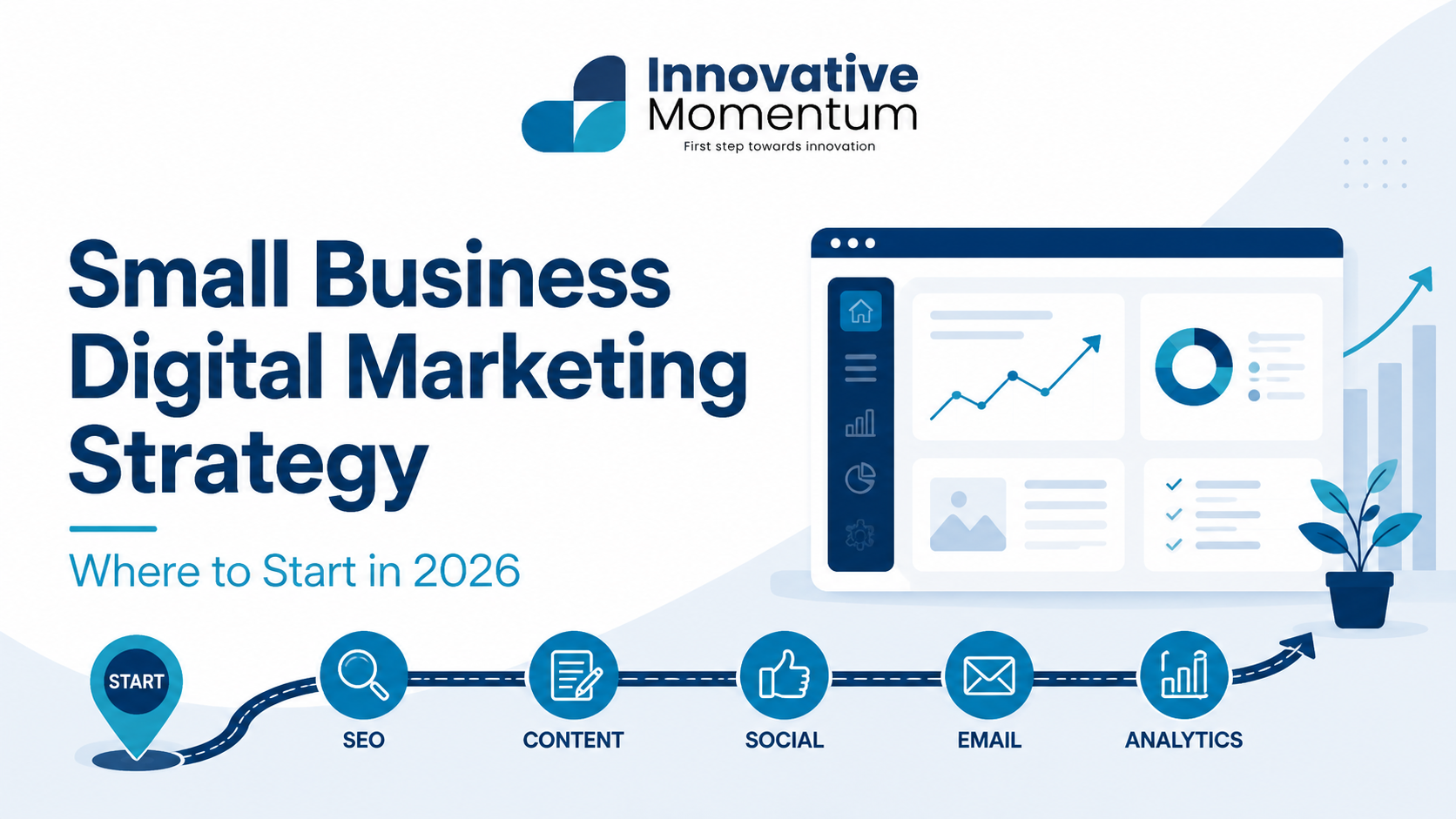
The path from first search to paying client determines which channels matter — map it before choosing any Paid traffic stops when you stop paying; SEO compounds over time — match the mix to your timeline New businesses need immediate visibility via Google Ads and GBP before organic channels produce results Email marketing delivers the highest ROI of any digital channel for businesses with an existing list Google AI Overviews, Perplexity, and ChatGPT are now a parallel visibility layer alongside traditional search
Most small businesses start digital marketing with the wrong question. They ask “which channel should I use?” when the right question is “what is the path from a stranger’s first search to a paying client?” That path determines which channels matter, in which order, and at what budget level. Without a clear conversion path, digital marketing spend diffuses across channels without compound effect — you get activity but not momentum.
This guide provides a practical framework for building a small business digital marketing strategy in 2026, from channel prioritization to measurement.
The 2026 small business digital marketing environment
Three structural changes in 2025-2026 affect how small businesses should approach digital marketing:
- AI search is a parallel channel: Google AI Overviews, Perplexity, and ChatGPT now answer a meaningful share of queries directly. Businesses that only optimize for traditional click-through traffic are missing an emerging visibility layer.
- Zero-click searches are increasing: Google answers more queries without any click, especially informational queries. This shifts value from traffic volume to brand visibility and authority building.
- Trust signals matter more: with AI-generated content flooding the web, the businesses that demonstrate genuine expertise and real results are pulling away from competitors with generic, undifferentiated content.
Channel prioritization by business stage
| Business Stage | Priority Channels | Why |
|---|---|---|
| New business (0-12 months) | Google Business Profile + Google Ads + referrals | SEO takes 6-12 months; paid search and GBP produce immediate visibility; referrals are zero-cost |
| Growing business (1-3 years) | SEO (content + local) + email marketing + GBP | Building compounding organic assets; email list becomes a direct line to interested prospects |
| Established business (3+ years) | SEO + content + paid retargeting + social proof + AI search | Multiple owned channels reduce dependence on any single platform; retargeting captures warm traffic |
Budget allocation framework
There is no universal right answer on channel budget allocation. It depends on your customer acquisition cost, margin, and where your specific customers actually find service providers like you. That said, common small business digital marketing budget ratios look like this:
Innovative Momentum
Want to implement these strategies for your business?
We help businesses grow with digital marketing, SEO, and AI-ready content strategies.
| Monthly Budget | Recommended Allocation |
|---|---|
| $500-$1,000/month | 80% SEO/content, 20% GBP management. Skip paid ads — insufficient budget for meaningful test results. |
| $1,000-$3,000/month | 50% SEO/content, 30% Google Ads (local service ads or branded), 20% GBP + citations. |
| $3,000-$8,000/month | 40% SEO/content, 30% paid (Google + retargeting), 15% email marketing, 15% social/PR. |
The compound asset principle: Paid traffic stops the moment you stop paying. SEO traffic compounds — a page ranking in position 3 today earns more authority and more traffic next year than this year. For any business planning to operate for more than 2 years, SEO and content produce the highest long-term ROI of any digital marketing channel.
The 90-day launch plan: what to do first if you’re starting from zero
Most marketing guides cover strategy but skip sequence. That gap is where small businesses get stuck. They read about 10 different channels, try to launch all of them at once, and end up with shallow presence everywhere and results nowhere. The following order of operations is designed for a business with a limited budget and no existing digital footprint.
Month 1: foundation
Do not spend money on advertising yet. You have no data, so any spending is guesswork. Month 1 is entirely about setting up the infrastructure that will tell you what is actually working.
- Set up Google Analytics 4 with conversion tracking configured (contact form submissions, phone click events, or whatever your primary lead action is). GA4 without conversion tracking is a pageview counter, not a business tool.
- Set up Google Search Console and submit your sitemap. This is how Google communicates indexing issues to you — and how you track which queries you rank for over time.
- Claim and fully complete your Google Business Profile. Add every service, write a detailed business description, upload at least 10 photos, and set your service area or address correctly. A half-completed profile performs dramatically worse than a complete one.
- Add your business to Apple Maps and Bing Places. Both are free and take under 20 minutes combined. Apple Maps feeds Siri results; Bing Places feeds Bing and Microsoft products. Neither replaces Google, but both are free citation sources.
“The biggest mistake new businesses make is trying to do all of this at once. Month 1 is analytics and Google Business Profile only. You need data before you spend money.”
Month 2: visibility
With tracking in place, you can now build content and citations that generate measurable results.
- Write and publish 2 long-form content pieces targeting high-intent keywords in your service area. “High-intent” means the searcher is evaluating providers, not just learning about a topic. “Best accountant for small business in [city]” is high-intent. “What is an accountant” is not.
- Build Tier 1 citations: Yelp, Facebook Business, and 2-3 relevant industry directories. Consistency matters here — your business name, address, and phone number must match exactly across every listing.
- Set up a basic email capture. A useful lead magnet (a checklist, a short guide, a free audit offer) converts 2-5% of site visitors into email subscribers. If a lead magnet feels like too much work at this stage, a simple “get our monthly tips” opt-in is enough to start building a list.
Month 3: amplification
By month 3, you have 60 days of conversion data, content indexed and starting to rank, and a small email list. Now you can spend money intelligently.
- Launch Google Search Ads on your top 2-3 service keywords. Keep the campaign tight: exact and phrase match only, a focused budget of $300-600/month to start, and send traffic to a dedicated landing page rather than your homepage.
- Set up a monthly email newsletter. One useful insight per month, not a sales pitch. Keep it short. Consistency over volume.
- Start responding to HARO (Help a Reporter Out, now operating as Connectively) queries in your topic area. A single placement in a relevant publication builds the kind of third-party authority that AI search systems and Google both weight heavily.
For a detailed breakdown of what each SEO budget tier actually delivers, that guide covers expected timelines and outputs at each spend level.
Adding AI search to your strategy
Businesses that want to appear in Google AI Overviews and get cited by Perplexity and ChatGPT need to add specific tactics to their content and technical strategy:
- Structure content for direct answers: FAQ sections, clear definitions, comparison tables, and specific numbered steps all perform well in AI citations.
- Build entity signals: consistent NAP across all directories, Organization schema on your website, and a Wikipedia-style knowledge panel presence.
- Allow AI crawlers: ensure GPTBot, ClaudeBot, PerplexityBot, and Applebot-Extended are not blocked in your robots.txt.
- Earn citations from authoritative sources: AI systems weight mentions from high-authority publications, industry directories, and review platforms more than your own content.
For the full framework on AI search optimization, our guide on Generative Engine Optimization for small business covers every tactic in depth.
Google Business Profile: the most underused digital marketing asset for local businesses
If you serve customers in a specific geographic area, Google Business Profile is almost certainly the highest-ROI digital marketing channel available to you. It is free to use, it feeds directly into Google Maps results, and it is the first thing most local searchers see before they ever visit your website. Most businesses claim their profile and then ignore it. That is a significant missed opportunity.
Four specific actions move the needle on GBP performance:
Posts: posting to GBP weekly (service updates, offers, news, or simple announcements) keeps the profile visibly active and signals engagement to Google’s local ranking algorithm. Posts expire after 7 days, so weekly cadence is the minimum. This takes about 10 minutes per week and costs nothing. For more on how GBP fits into a broader local SEO strategy, that guide covers the full picture.
Reviews: asking for reviews systematically is the single highest-impact action for local search visibility. “Systematically” means a follow-up email or text to every completed client, not a one-time ask. Businesses with 50 or more reviews and an average rating above 4.5 get significantly more calls from the local pack than businesses with 5-10 reviews, even when the lower-reviewed business has a higher average score. Volume and recency both matter to the algorithm.
Q&A: the Q&A section on a Google Business Profile is almost always empty, which means Google sometimes auto-populates it with questions and answers pulled from your website or other sources, and those answers are not always accurate. Get ahead of this by pre-populating the section yourself with the 5-8 questions you hear most from prospective clients. These appear directly in your knowledge panel and reduce friction for someone deciding whether to call you.
Photos: according to Google’s own GBP data, businesses with 10 or more photos receive 42% more direction requests than those with fewer. That is a meaningful difference in actual lead volume from a free action. Add photos of your space, your team, your work, and your service results. Update them quarterly so the profile looks current.
Email marketing: the channel most small businesses ignore until year 3
Email marketing has the highest ROI of any digital channel for businesses with an existing customer base. According to Litmus’s 2023 State of Email report, the average return is $36 for every $1 spent. That number is higher than paid search, paid social, and SEO for most businesses with an established list. Despite this, most small businesses either ignore email entirely or treat it as an afterthought until they are well past their launch phase.
The delay is understandable. When you have 50 contacts, sending a newsletter feels pointless. But the businesses that start building their list early are the ones who have 500 warm contacts by year 2 and 2,000 by year 4. An email list is an owned channel. No algorithm change wipes it out. No platform policy shift can remove your access to it. That matters.
Building a list without a big existing audience: a useful lead magnet converts 2-5% of site visitors into email subscribers. “Useful” means it solves a specific problem your target client actually has. A one-page checklist titled “7 questions to ask before hiring a web designer” will outperform “sign up for our newsletter” every time. If you do not have bandwidth to create a lead magnet in the first 6 months, a simple opt-in (“get our monthly tips”) still builds a list, just more slowly.
What to send: a monthly email with one genuinely useful insight or tip keeps unsubscribe rates below 0.3%. One promotional email per quarter for a relevant offer is acceptable and expected. What kills email lists is a high ratio of sales pitches to useful content. If 90% of what you send is useful and 10% is promotional, people stay subscribed and open rates stay above 25%. Flip that ratio and you will lose the list within a year.
Tools at each stage: Mailchimp is free up to 500 contacts and works well for simple monthly sends. Kit (formerly ConvertKit) is a better fit for content-driven businesses that want tagging and segmentation without complexity. ActiveCampaign is worth the added cost for businesses that need automation sequences, like a 4-email onboarding sequence for new inquiry leads.
The re-engagement play: if you have an email list with 500 subscribers who signed up 2 or 3 years ago and have not heard from you since, do not delete it and start over. Send one genuinely useful email, briefly acknowledge the gap, and watch who opens it. Open rates on re-engagement emails tend to run 10-20% for long-dormant lists. That is 50-100 people who are still interested in what you do. That is worth a conversation.
Measuring what works: the metrics that matter
| Metric | Why It Matters | Where to Find It |
|---|---|---|
| Organic leads / conversions | The only metric that ultimately matters — contacts and revenue from digital | GA4 Conversions filtered by organic source |
| Organic traffic growth (monthly) | Leading indicator of SEO momentum | Google Search Console Performance report |
| Keyword rankings for target terms | Shows whether content strategy is moving toward target positions | GSC Queries + Rank Math / Ahrefs position tracking |
| GBP calls and direction requests | Direct local search ROI signal — calls from map pack are high-intent buyers | Google Business Profile Insights |
Frequently asked questions
Should small businesses be on social media?
Social media is a brand awareness and trust-building channel, not a primary lead generation channel for most small B2B businesses. It is worth maintaining a consistent presence on the 1-2 platforms where your clients actually spend time. For B2B services, LinkedIn produces the strongest direct lead generation. For local consumer services, Facebook and Instagram can drive awareness. Do not spread across 5 platforms at low quality — pick one or two and be consistent.
Is email marketing still worth it in 2026?
Email has the highest ROI of any digital marketing channel for businesses with an existing customer base, typically $36-$40 returned per $1 spent. For new businesses without an email list, building one should be a medium-term goal rather than an immediate priority. Start by capturing emails with a useful lead magnet (a checklist, a guide, a free audit) and nurture with monthly useful content.
How much should a small business spend on digital marketing?
A common guideline is 7-12% of gross revenue for established businesses trying to grow, and up to 15-20% for new businesses trying to gain market share. Of that budget, the allocation in this guide suggests prioritizing SEO and content (50-80% in the early stages) over paid advertising. But the more useful question is: what is your cost to acquire a customer, and what is your customer lifetime value? If a new client is worth $5,000, spending $200-500 to acquire them through digital marketing is highly profitable at any reasonable conversion rate. That math is more instructive than any percentage-of-revenue rule. For a detailed breakdown of what different budget levels actually buy in SEO specifically, see our guide on how much SEO costs for small businesses.
My business is in a small local market. Do digital marketing strategies for larger businesses apply?
Most of them do, scaled down. The main difference is competition. In a small city, ranking on page 1 for “accountant [city]” requires far less effort than ranking nationally. Local businesses in smaller markets can often achieve meaningful organic results in 3-6 months with basic SEO and a well-optimized Google Business Profile, whereas national campaigns typically take 12-18 months to see compounding returns. The channels, the measurement approach, and the content principles are the same. The timeline and budget thresholds are just lower. That is actually an advantage — you can afford to compete effectively with a fraction of what a national brand spends.
To build a digital marketing strategy for your specific business, contact Innovative Momentum. We work with small businesses at every stage, from setting up the analytics foundation in month 1 to running multi-channel campaigns for established businesses looking to grow faster.

No comments yet. Be the first to share your thoughts.