
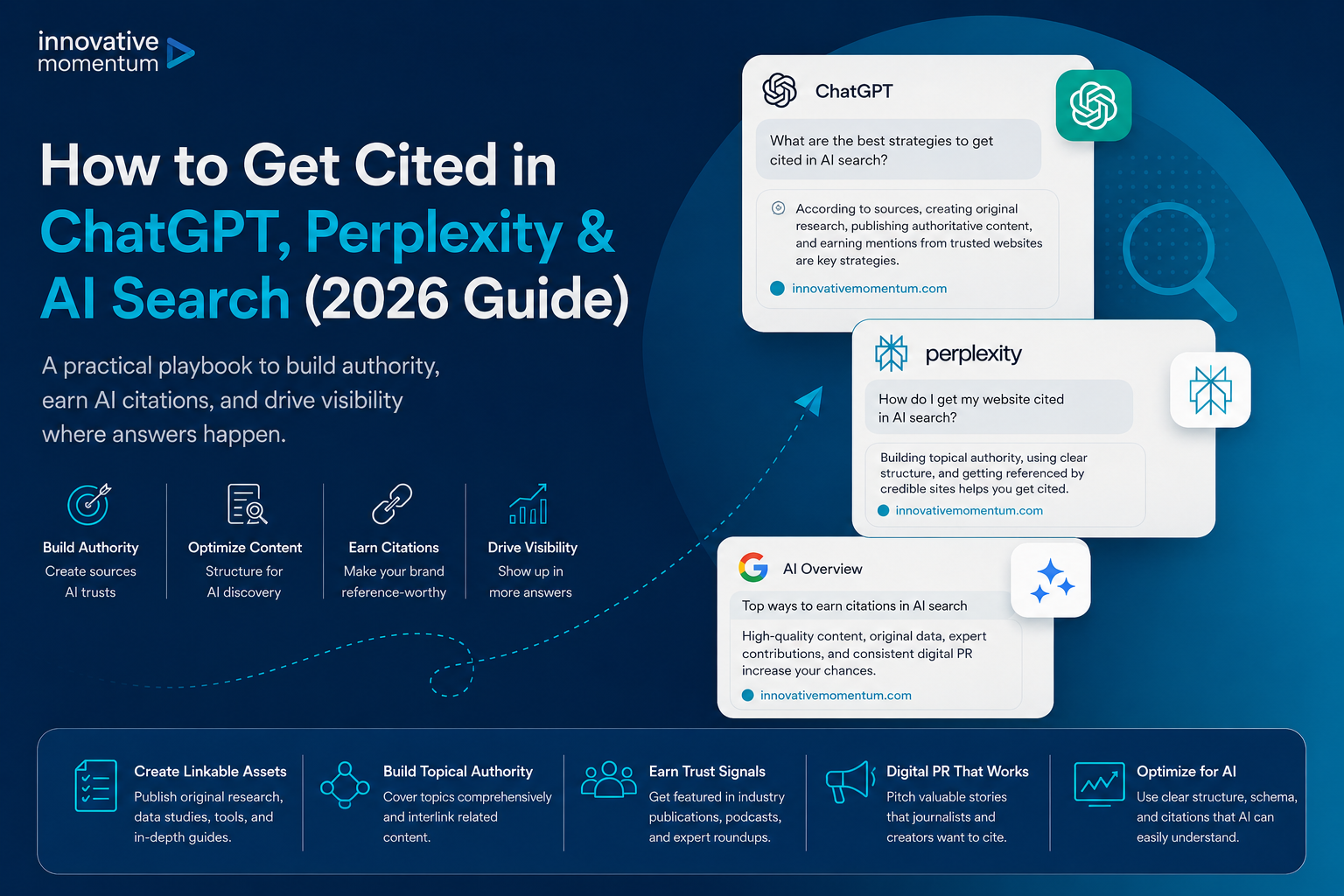
Key takeaway
Why Getting Cited in AI Search Is Different From Ranking on Google When someone searches Google, they see ten results and choose one.
Why Getting Cited in AI Search Is Different From Ranking on Google
When someone searches Google, they see ten results and choose one. When someone asks ChatGPT, Perplexity, or Google’s AI Overview the same question, they get one synthesized answer with one to three sources cited — sometimes none at all. If your business is not among those sources, you are invisible to that searcher entirely.
The good news: most small businesses are not optimizing for AI citation yet. The businesses that start now are locking in positions that will compound over the next two to three years, just as early SEO adopters built domain authority that still delivers traffic today.
This guide covers the specific, practical actions that increase your probability of appearing when your potential customers ask AI search tools questions in your area of expertise.
If you want to understand how AI search works conceptually before diving into tactics, our guide on what generative engine optimization (GEO) is covers the foundations.
Innovative Momentum
Want to implement these strategies for your business?
We help businesses grow with digital marketing, SEO, and AI-ready content strategies.
Step 1: Make Sure AI Crawlers Can Actually Read Your Site
This is the single most overlooked issue. AI systems cannot cite content they cannot read. Before anything else, check your robots.txt file at yourdomain.com/robots.txt and confirm you are not blocking AI crawlers.
The crawlers to allow explicitly:
- GPTBot (OpenAI / ChatGPT)
- ClaudeBot (Anthropic)
- PerplexityBot
- Google-Extended (Google AI Overviews)
- Applebot-Extended (Apple Intelligence)
- Bytespider (ByteDance / TikTok)
Many WordPress security plugins and some hosting configurations block all non-Googlebot crawlers by default. If you installed a security plugin in the last two years, check robots.txt now. A disallow rule is silently removing you from AI search consideration.
Add an llms.txt file at yourdomain.com/llms.txt. This file is a plain-text index of your services, key pages, and content that AI systems can parse in seconds rather than crawling every page. It is the fastest way to tell AI systems what your business does and where to find your best content.
Step 2: Build Consistent Brand Entity Signals Across the Web
AI systems build a model of every business entity they encounter. They pull data from Google Business Profile, LinkedIn, industry directories, press mentions, and your own website. The more consistent those signals are, the more confidently an AI system will cite you as an authority on a given topic.
Consistency means the same business name, address, phone number, website URL, and one-sentence description across every platform. A slight variation in how your name appears — “Innovative Momentum LLC” in one place and “Innovative Momentum” in another — reduces the AI’s confidence that these are the same entity.
Priority platforms to get right:
- Google Business Profile: This is the highest-weight entity signal for Google AI Overviews. Claim it, verify it, fill every field, and post at least once a month.
- LinkedIn company page: ChatGPT and Perplexity both pull heavily from LinkedIn for business entity data.
- Clutch and G2: For service businesses, these are the two directories that AI systems most frequently cite as sources when recommending agencies or service providers.
- Your own About page: Include your full business name, founding year, location, services, and team. Write it as a factual description, not marketing copy.
Step 3: Format Content to Answer Questions in the First Two Sentences
AI systems extract answers. They do not summarize pages — they find the sentence or paragraph that most directly answers the query and pull it. Content that buries the answer in paragraph four after three paragraphs of background does not get cited.
The pattern that works: state the direct answer in the first one or two sentences of each section, then support it with explanation, data, and context. Every H2 and H3 heading should be phrased as a question or direct statement that mirrors how someone would search for that information.
For example, a heading like “Our SEO Process” tells an AI system very little. A heading like “How We Audit an SEO Campaign for a Small Business” gives the AI a clear signal that this section answers a specific, searchable question. The second version is far more likely to be cited.
Step 4: Get Mentioned in Sources AI Systems Already Trust
AI systems are trained on content from across the web, but they weight certain sources heavily: established publications, government and educational sites, well-linked directories, and industry databases. When those sources mention your business, AI systems absorb that signal and start treating your business as a credible entity in your field.
The most practical way to get these mentions as a small business:
- Qwoted and Featured.com: These are journalist query platforms where reporters from publications like Forbes, Inc., and industry trade sites ask for expert quotes. Responding to two to three relevant queries per week consistently generates mentions in DA 70+ publications within two to three months.
- Industry directory listings: Clutch, DesignRush, GoodFirms, and UpCity are directories that AI systems regularly pull from when answering questions like “what are the best digital marketing agencies for small business.”
- Guest posts: A single well-placed article in a domain that AI systems regularly cite positions you as an expert on that topic for an extended period.
Step 5: Add Schema Markup to Service Pages and Key Content
JSON-LD schema markup is machine-readable metadata that tells AI crawlers exactly what your page is about. Without it, AI systems have to infer meaning from your content alone. With it, you are explicitly stating your entity type, service category, expertise area, and authorship.
The schema types that matter most for AI citation:
- Organization: Your business entity data — name, URL, logo, contact, social profiles.
- Service: For each service page — what the service is, who provides it, what area it serves.
- Article or BlogPosting: For every blog post — author, publish date, publisher, headline.
- Person: For your team’s About page entries — builds individual E-E-A-T authority that reflects on the business.
Schema does not change how your page looks to visitors. It adds a structured layer that AI crawlers read before they read your visible content. Pages with complete schema markup have a measurable advantage in AI search citation frequency over unstructured pages on the same topic.
Step 6: Publish Original Data and Research
AI systems strongly prefer citing primary sources over secondary commentary. If your content includes original statistics, original research, survey findings, or firsthand case study data, it becomes a primary source that other sites reference — and AI systems cite.
For small businesses, original data does not require a large research budget. Options that work:
- A survey of 20 to 50 of your own clients or industry contacts on a specific question
- An analysis of your own project outcomes aggregated into a statistic (example: “across 50 projects we delivered, average time-to-rank for a KD 30 keyword was 11 weeks”)
- A cost or pricing transparency page that publishes real numbers other businesses hide
Content with original data earns three to five times more backlinks than content without it, according to Ahrefs research. Backlinks signal authority to both traditional search engines and AI systems.
Step 7: Optimize the User Experience Signals on Your Site
AI systems that crawl your site assess more than content. Engagement signals — time on page, return visits, interaction rates — feed into authority assessments for Google AI Overviews specifically. A website that loads slowly, is hard to navigate on mobile, or gives visitors no way to engage sends negative quality signals.
For service businesses in particular, adding an accessible contact channel on key pages reduces bounce rate and gives visitors an immediate way to act. Tools like webchat widgets have been shown to increase engagement and conversion rates on service websites by giving visitors a lower-friction first step than a contact form — as covered in this analysis of how webchat widgets improve interaction on service sites. Higher engagement signals a quality resource, which feeds back into authority assessment.
Step 8: Build Topical Depth, Not Just Breadth
Publishing one article on a topic does not establish authority. AI systems assess whether a site covers a topic deeply across multiple related pieces. A site with five thorough articles on CRM setup for small businesses will be cited ahead of a site with one article, even if the single article is excellent.
This is why a content cluster strategy matters. Each article you publish on a related topic reinforces your authority on the broader subject. Our publishing calendar for this year covers 32 articles across five clusters — pricing, SEO, CRM and automation, AI search, and linkable assets — specifically to build topical depth in each area.
When planning content, map each article to a specific question your target customer asks at a specific stage of awareness. Top of funnel: what is it and how does it work. Middle: how do I choose and what does it cost. Bottom: how do I get started and who should I hire.
Step 9: Monitor and Test Your Citation Progress
You cannot manage what you do not measure. A simple monthly process:
- Open ChatGPT, Perplexity, and Google (for AI Overview) separately.
- Ask five to ten questions your potential customers search: “best digital marketing agency for small business,” “how much does SEO cost,” “how do I set up a CRM,” and similar queries in your service areas.
- Note which sources are cited. Track whether your business or content appears.
- For queries where competitors appear but you do not, review the cited source. What does it have that your content does not: more depth, better structure, original data, stronger schema markup?
Google Search Console is also useful here. Filter for informational queries where your pages have impressions but low clicks. This pattern — high impressions, low clicks — often means Google’s AI Overview is answering the query and absorbing the traffic. Those pages are candidates for GEO optimization.
The Compounding Effect
Each of these steps builds on the others. Schema markup makes your content easier to parse. Entity consistency makes your business easier to identify. Original data makes your content worth citing. Publication mentions make your entity more credible. Topical depth makes your authority harder to displace.
None of these actions produces results overnight. But the businesses that are consistent for six months will hold citation positions that late movers cannot easily take. The cost of starting now is a few hours per week. The cost of waiting until AI search is the dominant channel is a multi-year catch-up effort.
If you want help building out a complete AI search optimization strategy — including technical schema setup, content planning, and entity authority building — contact Innovative Momentum for a review of your current position.
For context on what the broader SEO investment looks like and how GEO fits within it, our guide on how much SEO costs for a small business breaks down budget tiers and what each level actually delivers.

Keep reading
Related insights
No comments yet. Be the first to share your thoughts.