
Key takeaway
GEO rewards depth and specificity. One authoritative article that directly answers a precise question outperforms fifty shallow posts. Start with three things: unblock AI crawlers in robots.txt, add an llms.txt file, and add schema markup to key pages.
What Is Generative Engine Optimization (GEO)?
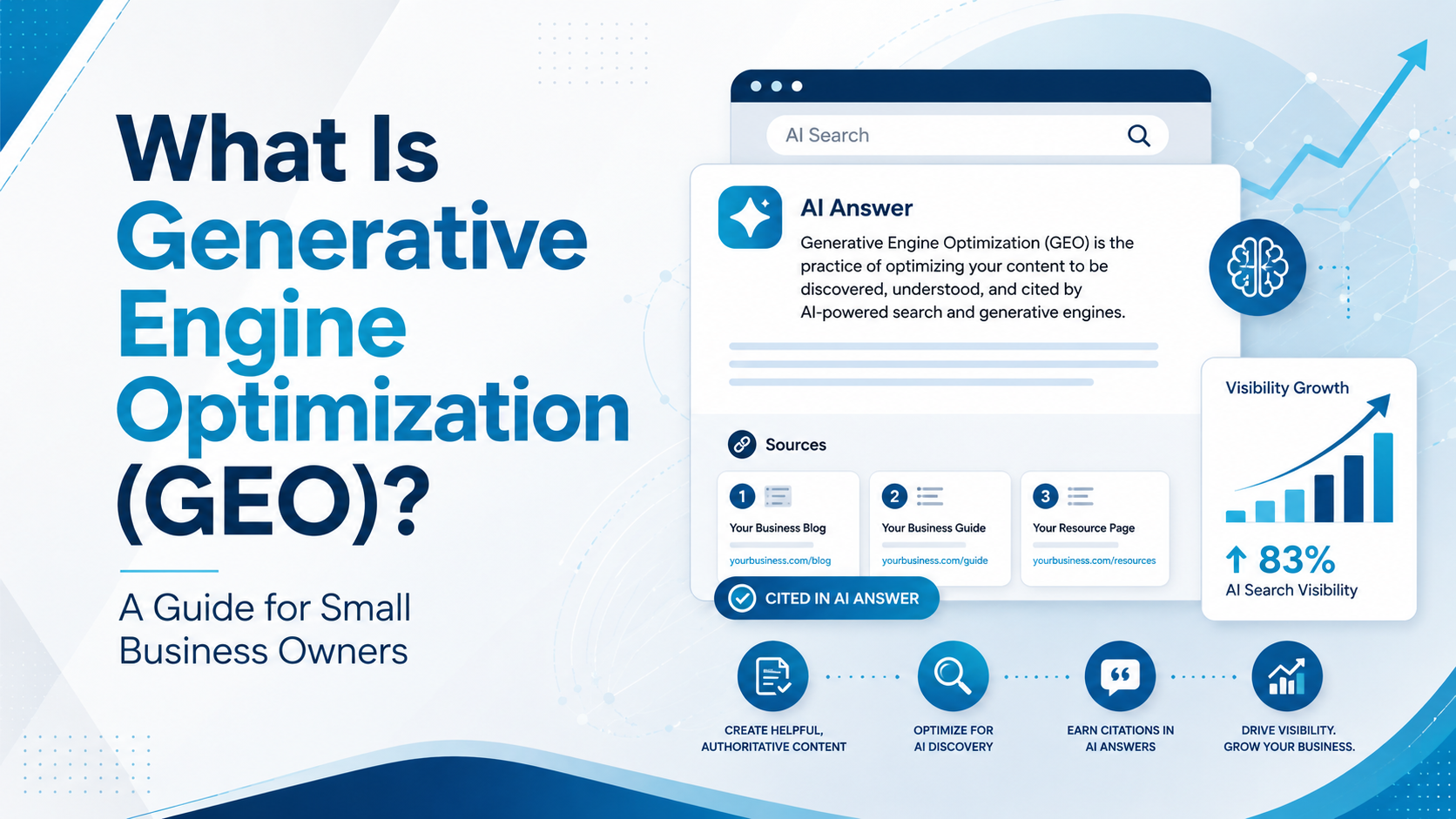
Generative Engine Optimization (GEO) is the practice of making your content more likely to be cited, quoted, or referenced in AI-generated answers. When someone asks ChatGPT, Perplexity, or Google’s AI Overview a question in your area of expertise, GEO is what determines whether your business gets mentioned or a competitor does.
It is not a replacement for SEO. It is an additional layer that has become necessary as a growing share of searches now get answered before the user ever visits a website.
Why This Matters for Small Businesses in 2026
Search behavior shifted faster in the last 18 months than it did in the previous decade. Google AI Overviews now appear on roughly 30 to 40 percent of all searches. Perplexity has crossed 100 million monthly active users. A significant portion of your potential customers are now getting answers from AI systems rather than clicking through to websites.
For small businesses, this creates two problems. The first is visibility: if your business is not being cited in AI answers, you are invisible to a growing share of searchers. The second is credibility: businesses that do appear in AI answers gain a trust signal that is difficult to replicate through traditional advertising.
Innovative Momentum
Want to implement these strategies for your business?
We help businesses grow with digital marketing, SEO, and AI-ready content strategies.
The good news is that most large competitors are not paying attention to this yet. Early movers in GEO are earning citation placements in AI answers that they will hold for years, much the same way early SEO adopters built domain authority that still compounds today.
How AI Search Engines Decide What to Cite
Traditional search engines rank pages. AI search engines synthesize answers and then attribute sources. The selection logic is different, and understanding it is the starting point for any GEO strategy.
AI systems draw on several signals to decide what to cite:
- Topical authority: Content that covers a subject in depth across multiple related pieces gets weighted more heavily than single-topic pages.
- Answer-shape formatting: Content that directly answers a question in the first two or three sentences is far more likely to be pulled into an AI response than content that buries the answer in the middle of a long page.
- Structured data: Schema markup signals to AI crawlers what a piece of content is about, who wrote it, and what entity it belongs to.
- E-E-A-T signals: Experience, Expertise, Authoritativeness, and Trustworthiness indicators that Google first formalized for search quality now directly influence how AI systems weight sources.
- Citation patterns: When other credible sources link to or reference your content, AI systems treat your content as a stronger authority.
- Crawl access: AI crawlers like GPTBot, ClaudeBot, and PerplexityBot must be able to access your site. Blocking them in robots.txt removes you from consideration entirely.
The Difference Between SEO and GEO
Traditional SEO optimizes for a ranked list of ten blue links. GEO optimizes for a synthesized answer that may reference one to three sources. The audience is the same. The competition for attention is more concentrated.
In traditional SEO, ranking third or fourth on a page still delivers traffic. In AI search, the answer is generated once and sources are cited occasionally. If you are not in the top one or two references, you may not be referenced at all.
This means GEO rewards depth and specificity over breadth. A single authoritative article that answers a precise question thoroughly outperforms a site with 50 shallow blog posts on loosely related topics.
GEO also rewards brand entity clarity. AI systems need to know that your business is a distinct, credible entity with a consistent name, address, website, and area of expertise. Inconsistent NAP data, no Google Business Profile, and no structured markup all reduce the probability that an AI system will confidently cite you.
Six Practical Steps to Optimize for AI Search
1. Open Your Site to AI Crawlers
Check your robots.txt file at yourdomain.com/robots.txt. Look for rules that block GPTBot, ClaudeBot, PerplexityBot, Applebot-Extended, Google-Extended, and Bytespider. If any of these are disallowed, AI systems cannot read your content and will not cite you.
Add a robots.txt entry that explicitly allows AI crawlers, or at minimum ensures they are not blocked. This is the fastest, highest-leverage GEO action you can take today.
2. Create an llms.txt File
llms.txt is an emerging standard for helping AI systems understand your site structure. It sits at yourdomain.com/llms.txt and provides a plain-language index of your services, content, and expertise in a format that large language models can easily parse.
Include your business description, core services with URLs, and key content pieces. Keep it factual and structured. AI systems use this file as a fast-read alternative to crawling every page on your site.
3. Format Content to Answer Questions Directly
AI systems pull answers from content that states the answer clearly at the top of the section, not content that builds to an answer over four paragraphs. When writing a blog post or service page, identify the core question the page answers and put the direct answer in the first one to two sentences of each section.
Use clear H2 and H3 headings that match the way someone would phrase a question. Use numbered lists and bullet points for steps and comparisons. These formats are far more likely to appear in AI-generated answers than dense paragraph copy.
4. Add Schema Markup to Every Key Page
JSON-LD structured data tells AI crawlers (and Google) exactly what your page is about. At minimum, every service page should have an Organization schema and a Service schema. Blog posts should have Article schema with author, datePublished, and publisher fields filled in. FAQ schema is useful for question-and-answer content.
Schema markup does not change how your page looks to human visitors. It adds a machine-readable layer that AI systems use to identify and categorize your content. Pages without schema markup are harder for AI systems to categorize confidently, which reduces their likelihood of being cited.
5. Build Consistent Entity Signals
AI systems build a model of your business as an entity. The more consistent signals they can find across the web, the more confidently they reference you. Entity signals include your business name, address, phone number, website URL, and description appearing consistently across Google Business Profile, LinkedIn, industry directories, and other platforms.
Claim your profiles on Clutch, G2, DesignRush, and GoodFirms if you have not already. Each listing reinforces your entity data and contributes to the authority score AI systems use when deciding whether to cite a source.
6. Earn Citations From Other Credible Sources
When other credible websites reference your content, link to your research, or quote your expertise, AI systems treat your content as a higher-authority source. The same backlink-driven authority model that powers traditional SEO applies here, with one addition: AI systems also weight mentions (unlinked references to your business name) as authority signals.
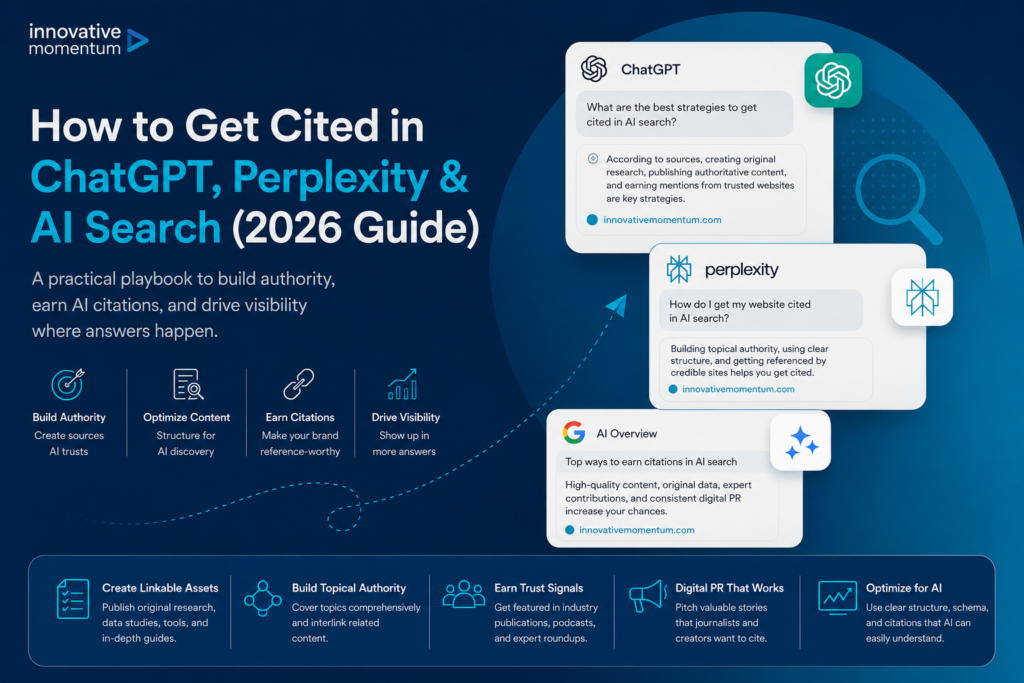
Getting quoted in industry publications, contributing to expert roundups, and publishing original research or statistics are the fastest ways to build citation authority that feeds into AI search rankings. A single placement in a high-authority publication can move you into AI answer sources for that topic within weeks.
How to Track Whether GEO Is Working
GEO is harder to track than traditional SEO because AI systems do not always disclose their sources in a searchable way. The most practical approach for small businesses right now:
- Manual queries: Ask ChatGPT, Perplexity, and Google AI Overviews the questions your customers most commonly search. Note which businesses and sources are cited. Repeat monthly.
- Google Search Console: Track impressions and clicks for informational queries. A drop in clicks with stable or rising impressions often indicates AI Overviews are answering the query without sending traffic, which tells you which pages need GEO attention.
- Brand mentions: Set up Google Alerts for your business name. When AI-generated content gets published that cites you, it often gets picked up by other sites that link back.
GEO optimization does not produce overnight results, but the compounding effect is significant. The businesses that start now will hold citation positions that are difficult to displace once the AI systems have learned to treat them as authorities on their topics.
How GEO Relates to Your Broader Digital Marketing Investment
GEO is most effective when built on a foundation of solid traditional SEO. If your site has technical problems, thin content, or no structured data, fixing those gaps benefits both traditional and AI search at the same time.
Before investing heavily in GEO-specific tactics, it is worth understanding what your baseline SEO investment should look like. The costs and priorities are closely related. Our guide on how much SEO costs for a small business breaks down what different budget levels actually buy and what to expect at each tier.
For businesses running on HubSpot, GEO also connects directly to how your website is structured. CMS-editable pages with clean URL structures, schema markup support, and accessible content architecture are easier for AI crawlers to parse than page-builder outputs with inconsistent heading hierarchies. Our guide on HubSpot website design for B2B teams covers how this connects to content architecture decisions at the build stage.
The Timeline: When to Expect Results
For low-competition GEO keywords (queries where no current sources are clearly established as authorities), the timeline is shorter than most businesses expect. Some correctly optimized pages begin appearing in AI search answers within four to eight weeks of publishing.
For competitive queries where established publishers already dominate AI answers, the timeline is longer: six to twelve months of consistent publishing and citation-building. The strategy in those cases is not to beat existing authorities head-on but to own specific sub-topics and long-tail questions where you can establish clear authority faster.
The businesses that will benefit most from GEO are those that start building their content and entity authority now, before AI search matures and the positions become locked in by early movers.
Getting Started This Week
Three actions that take under two hours combined and have immediate GEO impact:
- Check robots.txt for blocked AI crawlers and remove any blocks.
- Create or update your llms.txt file with your service list and key content URLs.
- Add JSON-LD Organization and Service schema to your homepage and top service pages.
If you want help auditing your current GEO readiness or building out a content strategy that covers both traditional SEO and AI search optimization, contact Innovative Momentum for a review.

Keep reading
Related insights
No comments yet. Be the first to share your thoughts.