
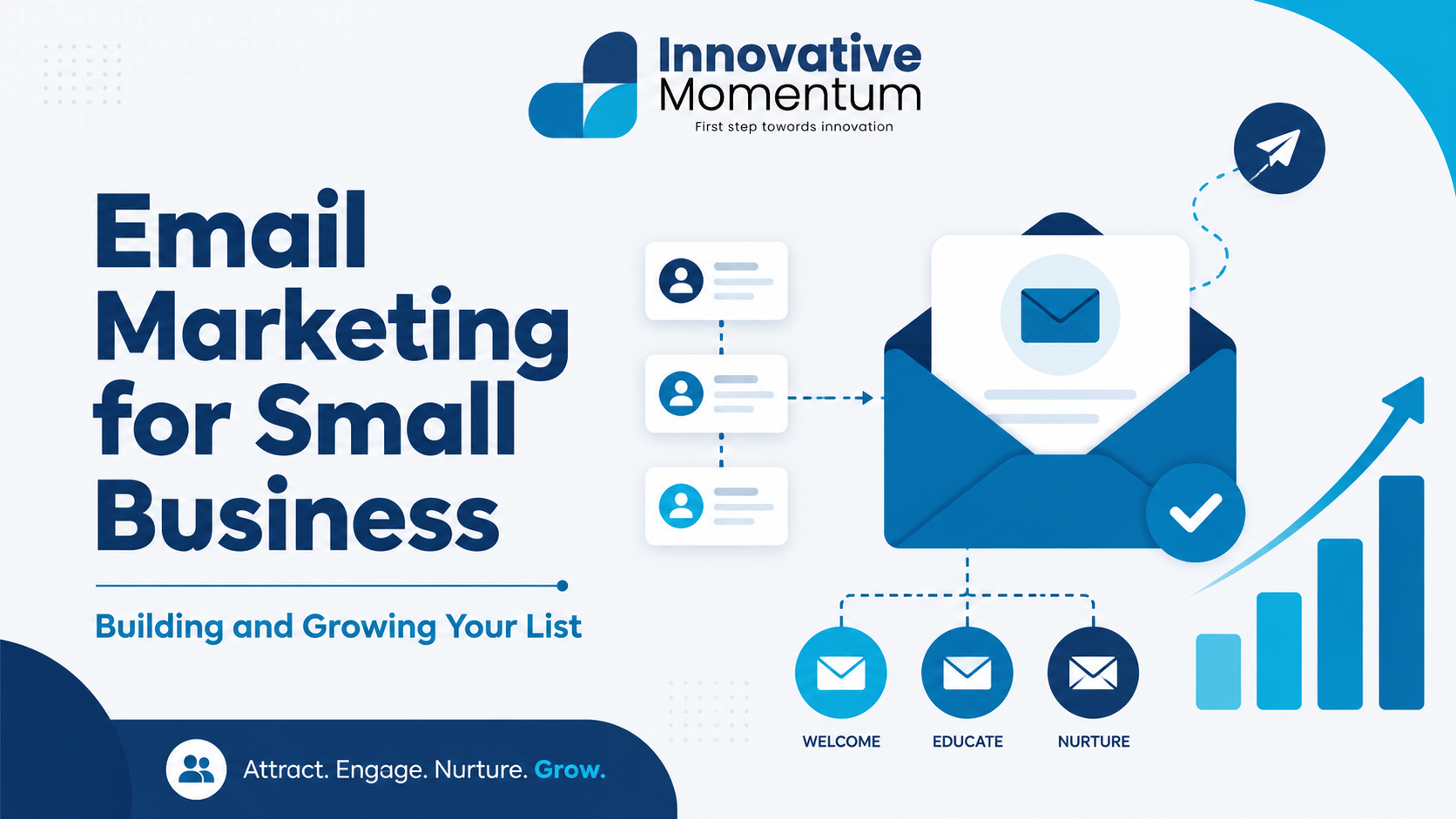
Key takeaway
The fastest way to build a quality list is a specific, valuable lead magnet promoted on your highest-traffic page. Quality beats quantity: 500 targeted subscribers outperform 5,000 random ones.
Email marketing consistently delivers higher ROI than any other digital marketing channel for small businesses. The reason is straightforward: your email list is an audience you own. Unlike social media followers (where your reach depends on an algorithm you do not control) or organic search traffic (which can drop after a Google update), an email list is a direct, reliable channel to people who have already expressed interest in your business.
This guide covers how to build an email list from scratch, what content to send, how to grow beyond the initial subscriber base, and the tools and automation that make email marketing sustainable for a small business without a dedicated marketing team.
Why Email List Building Comes Before Email Marketing
Most email marketing guides start with “what to send” — but for a small business with no existing list, the first problem is building an audience worth sending to. An email list of 200 engaged subscribers who opted in specifically to receive your content is worth more than 2,000 passive contacts scraped or purchased from a directory. Engagement rate (open rate, click rate) determines whether email providers deliver your messages to inboxes or spam folders. A low-quality, unengaged list damages deliverability for everyone on it, including your best prospects.
The foundation of list building is the value exchange: you give something genuinely useful, the visitor gives their email address. The higher the perceived value of what you offer, the higher the conversion rate from visitor to subscriber.
Innovative Momentum
Want to implement these strategies for your business?
We help businesses grow with digital marketing, SEO, and AI-ready content strategies.
Lead Magnets: What Actually Works in 2026
A lead magnet is the resource, tool, or access you offer in exchange for an email address. Generic lead magnets (“Sign up for our newsletter!”) fail because they offer nothing specific. Effective lead magnets in 2026:
- Specific, actionable guides: A checklist, template, or step-by-step guide solving one specific problem your target audience has. “The 15-Point Website Checklist Before You Launch” outperforms “Digital Marketing Guide” because it is specific and immediately usable.
- Tools and calculators: ROI calculators, pricing estimators, and diagnostic tools provide personalized value that general content cannot. They also attract prospects who are actively considering purchasing — the highest-quality segment of your audience.
- Free consultations or audits: For service businesses, a short free consultation or audit (30 minutes, a review of one aspect of their business) is a lead magnet and a sales opportunity simultaneously. The email is required to book; the consultation begins the sales relationship.
- Access to specific content: Gated case studies, in-depth reports, or industry research work particularly well for B2B services because they signal that the content has enough value to be behind a gate.
Lead magnets should be directly related to your core service. A web design agency offering a website audit as a lead magnet attracts people evaluating their website — the exact audience who might hire a web design agency. A free SEO checklist attracts people interested in SEO, who may or may not also need web design. Specificity to your target buyer makes lead magnets both easier to create and more effective at attracting the right subscribers.
Where to Place Opt-In Forms
Visibility determines sign-up rate. The most effective positions for email opt-in forms:
- Exit-intent popup: Appears when a visitor moves their cursor toward the browser close button, signaling exit intent. Converts between 2-5% of exiting visitors when the offer is relevant. Used thoughtfully, exit popups capture subscribers who would otherwise leave with no connection to your business. Overused or poorly timed, they are annoying and damage the experience — do not show them on a visitor’s first 30 seconds on the site.
- End of blog posts: Visitors who read an entire blog post have demonstrated interest in your content and are the most qualified subscribers. A contextual opt-in at the end of each post (“Want more guides like this? Join 1,400 business owners on the list”) has high conversion rates because the reader has already self-selected as interested.
- Dedicated landing page: A single page focused entirely on the email list sign-up, linked from navigation and blog posts. Useful for paid traffic campaigns where you want to drive specific audience segments to the list.
- Homepage above the fold: For businesses where the email list is a primary product or the lead magnet has broad appeal, homepage placement is appropriate. For most service businesses, the above-fold area should be reserved for the primary service CTA, with email sign-up further down the page.
Welcome Sequence: The First 5 Emails
The welcome sequence is the most-read email you will ever send. Open rates for welcome emails average 50-80% — far above typical campaign open rates of 20-30%. The first email after sign-up should be delivered immediately and deliver the lead magnet if one was promised. Beyond delivery, the welcome sequence builds the relationship that determines whether new subscribers remain engaged or disengage after the first email.
A 5-email welcome sequence structure that works for service businesses:
- Email 1 (immediate): Deliver the lead magnet. Introduce yourself briefly. Set expectations for what subscribers will receive and how often.
- Email 2 (day 2): Your most useful free piece of content — your best blog post, a key insight, or a common mistake you see. No selling. Pure value.
- Email 3 (day 4): A success story. One client result with specific numbers. This builds credibility without a sales pitch.
- Email 4 (day 6): A question that qualifies the subscriber — “What is your biggest challenge with your topic right now?” Replies create personal connections and give you intelligence about what your audience needs.
- Email 5 (day 10): A soft offer — introduction to your core service, with an invitation to book a free consultation if relevant. At this point, you have delivered value four times before mentioning what you do commercially.
Regular Email Content: What to Send
Consistency beats frequency. A weekly email you can sustain beats a daily email you abandon after two weeks. For most small businesses, one email per week or one per fortnight is the right cadence. Content that performs well for service business email lists:
- One insight per email: A specific observation, tip, or lesson — not a summary of five things. Single-topic emails with a clear point are read more fully than roundup newsletters.
- Behind-the-scenes: What you are working on, a problem you solved for a client this week (anonymized if needed), or a decision you made and why. This content is impossible to get anywhere else and builds intimacy with the brand.
- Links to new content: When you publish a new blog post, the email list gets it first. This drives traffic, increases time-on-site for engaged readers, and reinforces the value of being on the list.
For content strategy aligned with your email marketing, our guide on content marketing for small businesses covers the editorial planning approach that ensures you always have something worth sending.
Email Marketing Tools for Small Businesses
For B2B service businesses, HubSpot’s free CRM with email marketing is worth considering because it connects email campaigns to a contact database with full interaction history. Our guide on HubSpot website design for B2B covers how to use HubSpot’s full platform beyond just email, including lead scoring and sales pipeline integration.
For a complete B2B lead generation strategy incorporating email marketing, see our guide on B2B website lead generation tactics. For email marketing strategy and implementation support, contact Innovative Momentum.
Frequently Asked Questions
How large does an email list need to be before it is worth marketing to?
A focused list of 100 highly relevant subscribers is worth more than 1,000 unengaged contacts. The list does not need to be large to be valuable — it needs to contain the right people. A financial planner with 200 subscribers who are all business owners in their target market, who opened the last three emails, is sitting on a significant pipeline. Start sending as soon as the first subscriber joins; do not wait for scale.
How often should I email my list?
Consistently enough that subscribers remember who you are when your email arrives, but not so frequently that they feel overwhelmed. For most small businesses, weekly or fortnightly is appropriate. The right frequency is the highest frequency at which you can maintain quality — an email sent because you need to hit a frequency target, with nothing genuinely worth saying, trains subscribers to stop opening your emails.
What is a good open rate for a small business email list?
Industry averages for B2B email marketing in 2026 range from 20-30% open rate. However, open rates have become less reliable as Apple Mail Privacy Protection (enabled on most Apple devices since 2021) pre-opens emails to load tracking pixels, inflating open rates. Click rate (subscribers who click a link) is a more reliable engagement metric — 2-5% click rate is typical for a healthy, engaged list.
Email Deliverability: Getting Into the Inbox
Building an email list is only half the challenge — your emails need to reach the inbox to be effective. Email deliverability is determined by three technical factors and one behavioral factor. The technical factors: SPF (Sender Policy Framework), DKIM (DomainKeys Identified Mail), and DMARC records configured in your domain’s DNS settings. These records authenticate that your emails are genuinely sent from your domain, rather than spoofed. Most major email marketing platforms (Mailchimp, ConvertKit, ActiveCampaign) provide setup instructions for these records — configuring them is a one-time DNS change that takes about 30 minutes.
The behavioral factor: engagement rate. Email providers filter messages based on how recipients interact with your emails. Lists with high open rates and click rates are delivered to inboxes; lists with low engagement (or high spam complaint rates) are sent to spam or promotions folders. Maintain deliverability by:
- Removing unengaged subscribers (no opens in 6 months) with a re-engagement campaign before deletion
- Never purchasing email lists — purchased lists have no opt-in relationship and generate spam complaints
- Making unsubscribing easy — a visible unsubscribe link reduces spam complaints by giving unhappy subscribers a clean exit
- Sending consistently rather than sporadically — sudden bursts of email after long periods of silence trigger spam filters
Segmentation: Sending the Right Message to the Right People
List segmentation means dividing your subscribers into groups based on their characteristics or behavior, and sending different content to each group. Segmented email campaigns deliver significantly higher open and click rates than broadcast campaigns sent to the entire list — because the content is specifically relevant to each segment’s situation.
Simple, high-impact segmentation strategies for small service businesses:
- By service interest: Subscribers who opted in via a specific lead magnet (e.g., a guide about web design) are likely interested in web design services. Segmenting these subscribers and sending them content about web design, rather than your full service mix, increases relevance and conversion rate.
- By engagement level: Separate highly engaged subscribers (opened last 5 emails) from unengaged ones (not opened in 3 months). Engaged subscribers receive normal campaigns; unengaged ones receive a win-back sequence before being removed from the list.
- By buyer stage: New subscribers in the welcome sequence receive introductory content. Long-term subscribers who have been on the list for over 6 months receive content that assumes familiarity with your business and focuses on conversion.
For the broader content strategy that fuels your email list, see our guide on content marketing for small businesses. For implementation support with email marketing, contact Innovative Momentum.
Growing Your List Through Content Upgrades
A content upgrade is a lead magnet that is specific to a single piece of content rather than generic to your whole site. A blog post about IR35 compliance might offer a downloadable IR35 contract checklist. A guide on Google Ads offers an example campaign structure spreadsheet. Because the offer is directly relevant to what the reader is already engaged with, content upgrades typically convert at 3-5x the rate of generic site-wide lead magnets. For small businesses with an active blog, adding a relevant content upgrade to each high-traffic post can build a significantly larger and better-qualified email list than a single generic opt-in. Our guide on content marketing for small businesses covers the blog and content strategy that creates the traffic these upgrades convert. For help building an email marketing system, contact Innovative Momentum.

Keep reading
Related insights
No comments yet. Be the first to share your thoughts.