
Key takeaway
E-E-A-T is not a direct ranking signal but shapes how Google evaluates content quality overall The first E (Experience) added in 2022 means first-hand knowledge now outweighs credentials alone Author bios, a detailed About page, and visible contact information are the fastest E-E-A-T wins Schema markup makes implicit expertise explicit for Google's automated quality systems Testimonials and case studies function as Experience signals, not just sales tools
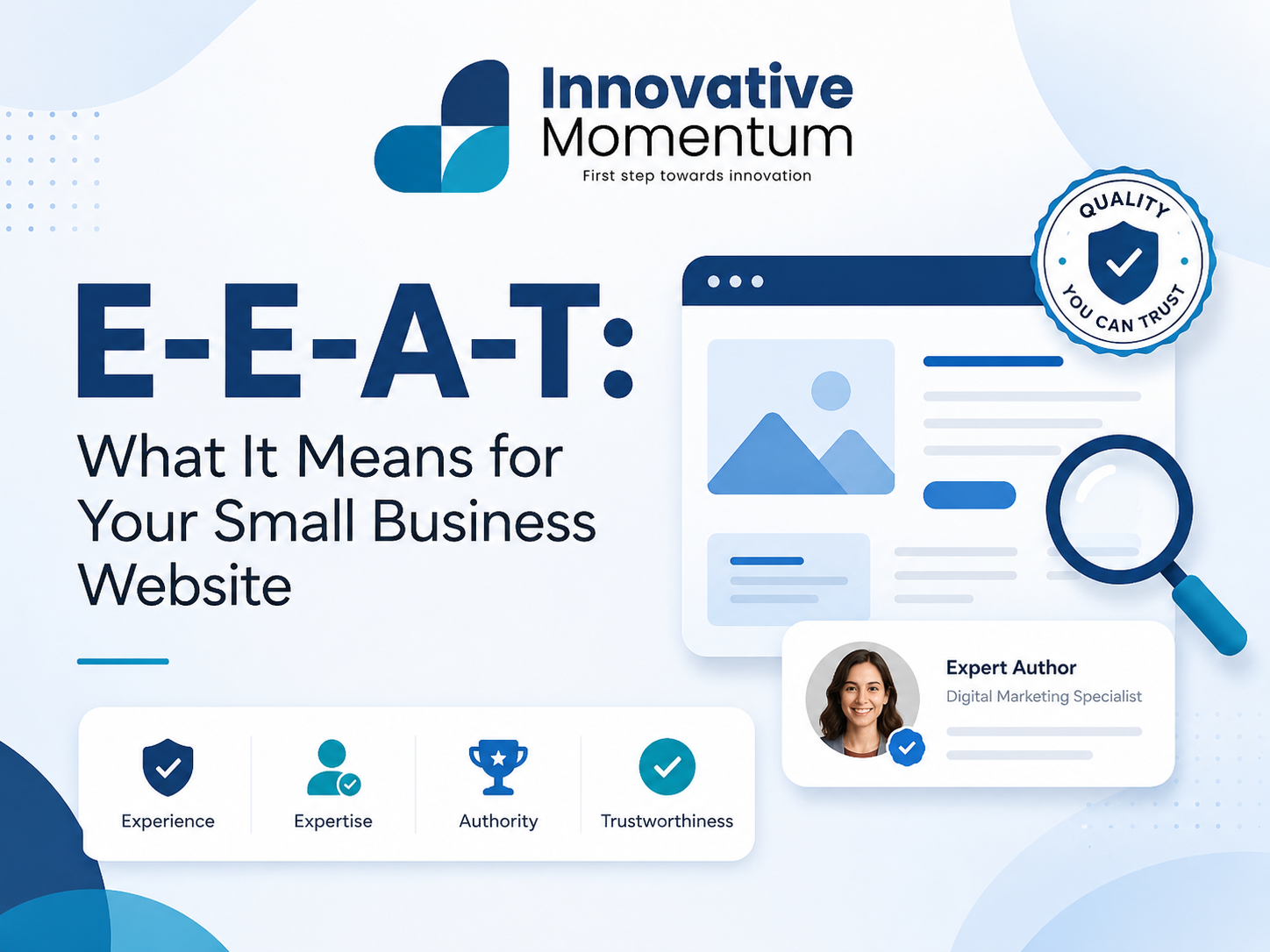
E-E-A-T stands for Experience, Expertise, Authoritativeness, and Trustworthiness. Since December 2022, when Google added “Experience” to the original E-A-T framework, these four signals have become the lens through which Google’s quality raters evaluate content quality — and increasingly, the signals that determine whether your pages rank in competitive queries. As of December 2025, Google has confirmed that E-E-A-T applies to all competitive queries, not just YMYL (Your Money, Your Life) topics.
For small businesses, this is both a challenge and an opportunity. You cannot fake E-E-A-T. But if your business has genuine experience and real customer results, the signals that demonstrate that to Google are specific, achievable, and far less expensive than most people assume.
What each letter actually means
The 2026 update: Google’s quality raters guidelines confirm that Trust is the most important of the four signals, and that the other three contribute to trust. A site with strong expertise but a bad trust record (inaccurate claims, no contact info, hidden ownership) will still rank poorly. Build trust first.
E-E-A-T signals you can add to your website
Author and business entity signals
- Author bio pages: Every piece of content should have a named author with a bio that lists real credentials, experience, and links to their LinkedIn profile. Generic “Admin” or “Staff Writer” bylines actively hurt E-E-A-T.
- About page depth: Your About page should describe who founded the business, how long you have been operating, real staff names and roles, and specific experience statements — not marketing copy.
- Person schema markup: Add JSON-LD Person schema to author pages linking their name to their LinkedIn, their published works, and their professional credentials. This is the machine-readable version of the bio signal.
- Organization schema: Add Organization schema with your founding date, number of employees, social profiles, and contact information. This builds your entity in Google’s Knowledge Graph.
Content-level signals
- Case studies with real numbers: “We helped a client grow organic traffic” is not an experience signal. “We helped a Dallas roofing company grow from 300 to 2,400 monthly visitors in 8 months” is. Specific results, real clients (with permission), dated.
- Original research and data: Surveys, client data aggregated and anonymized, internal benchmarks. Original data earns backlinks naturally, which builds authority.
- Updated dates on content: Content with a visible “Last updated: [date]” signal performs better in competitive queries than undated content. Update key posts at minimum annually.
- Expert quotes and citations: Citing named industry experts, studies, and authoritative sources reinforces expertise. Link to primary sources, not summaries.
Trust signals
E-E-A-T and AI search
Google’s E-E-A-T framework directly influences which sources AI Overviews cite. ChatGPT and Perplexity use similar signals: credibility cues, named authors, sourced data, consistent entity signals when deciding which businesses to reference. Building E-E-A-T for Google simultaneously builds your AI citation profile.
Innovative Momentum
Want to implement these strategies for your business?
We help businesses grow with digital marketing, SEO, and AI-ready content strategies.
The most impactful single action: add a named, credentialed author bio to every blog post and content page on your site, with Person schema markup. This one change signals experience and expertise simultaneously and is visible to both Google’s quality raters and AI crawlers.
E-E-A-T audit: seven questions to ask about your own site
Before investing in new content, audit what you already have. Google’s quality raters work from a 170-page document called the Search Quality Evaluator Guidelines, and they are trained to look for specific signals, not general impressions of quality. These seven questions map directly to what that evaluation process checks.
“Raters are asked to find information about the author of a piece of content, the website itself, and the reputation of both. If they cannot find any information, that absence is itself a signal.” — Search Quality Evaluator Guidelines (Google, v. October 2024 edition)
Work through each question with a yes or no. Every “no” is a fixable gap.
1. Does every blog post show a named author with verifiable credentials? Not a pen name, not “the Innovative Momentum team.” A real person whose name you can search and find. If you cannot name the author, a quality rater cannot verify their expertise either.
2. Do your case studies include specific numbers? Not “we helped them grow” but actual figures: traffic volume, revenue change, time period, starting baseline. Vague claims read as unverifiable. A real client outcome from six months ago with real numbers outweighs ten generic success stories.
3. Does your About page name real people with real credentials? Founding year, professional background, named team members, maybe a photo or two. If your About page reads like it was written to sound good rather than to inform, it is not working as an E-E-A-T signal.
4. Are your key pages dated and visibly updated? A blog post from 2021 with no “last updated” notice signals stale content to both raters and algorithms. Competitive pages need visible freshness cues.
5. Do you have reviews on more than one platform? Google reviews alone are not enough. A quality rater checking your reputation will look at Google Business Profile, Yelp, Facebook, industry directories, and the BBB. Fifty reviews on Google and nothing elsewhere is a thin trust profile.
6. Are your NAP details (name, address, phone) identical across every directory? One character difference between your Google Business Profile and your website footer creates a trust inconsistency. For businesses focused on local SEO, consistent NAP is among the highest-leverage fixes available.
7. Can someone find your physical address, a direct phone number, and a named contact without submitting a form? A contact form is not a substitute for real contact details. Quality raters are specifically instructed to check whether a website makes it easy to reach the business through conventional means.
E-E-A-T by business type: what signals matter most
Not every E-E-A-T signal carries equal weight across all business categories. A personal injury law firm needs different signals than a SaaS company selling project management software. The table below narrows it down to what actually moves the needle per business type, with one concrete action you can take this month.
Common E-E-A-T mistakes that hurt rankings
Most E-E-A-T problems are not technical. They are decisions that seemed reasonable at the time: keeping content authorship vague to avoid internal politics, copying testimonials from a sales deck onto the website, treating the About page as an afterthought. Four patterns come up repeatedly across sites that struggle to rank despite publishing consistent content.
The most common is publishing content under a generic “Admin” byline. This happens in WordPress sites where the default admin account was used to publish early posts and no one changed it. To a quality rater, “Admin” signals that the business either does not want to put a real name to their advice or has no specific person qualified to give it. Either reading damages E-E-A-T. Every published post needs a real author with a bio and a profile picture, even if it is the business owner writing under their own name.
Vague testimonials are the second pattern. “Great service, highly recommend” attributed to “J.S. from Texas” is not a trust signal. It is easy to fabricate and hard to verify. Compare that to a named client, with their company, describing a specific outcome: “Before working with them, we were getting 12 leads a month from organic search. Six months later we were at 47.” That is a trust signal. Specificity is what separates a credible testimonial from filler.
Having no About page, or an About page with no real credentials, is the third mistake. Google’s quality raters are explicitly instructed to look for information about who is responsible for the website’s content. A one-paragraph About page that says “we are passionate about helping businesses grow” tells a rater nothing verifiable. The About page is not a formality. It is one of the highest-leverage E-E-A-T pages on the site.
The fourth mistake is ignoring review consistency across platforms. A business with 80 five-star Google reviews and a 2.8 average on Yelp has an obvious reputation problem that any quality rater, or any skeptical customer, will find immediately. But even without negative reviews elsewhere, having no reviews on any platform except Google is a thin trust profile. Active reputation management across Google, Facebook, and at least one industry-specific directory should be part of the ongoing work, not a one-time effort.
Frequently asked questions
Does E-E-A-T directly affect my rankings?
E-E-A-T is not a direct ranking factor with a numeric score. It is a framework Google’s quality raters use to evaluate content quality, which then informs how Google trains its ranking algorithms. The practical effect is that content with strong E-E-A-T signals outperforms thin, anonymous, or uncredentialed content in competitive queries, particularly since the 2023 to 2025 Helpful Content updates.
Can a small business compete on E-E-A-T with large brands?
Yes, and often more effectively. A small business owner who has personally built 200 decks can demonstrate first-hand experience that a content marketing team at a large company cannot fake. The key is making that experience visible through specific case studies, named authors, real project photos, and original client results.
How long does it take to see E-E-A-T improvements in rankings?
E-E-A-T improvements are not instant. Adding author bios and schema typically shows results in 2 to 4 months as Google re-crawls and re-evaluates pages. Building external authority signals (backlinks, mentions, reviews) takes 6 to 12 months to accumulate meaningfully. Treat it as a long-term investment, but the compound effect is substantial.
What is the difference between E-E-A-T and domain authority?
Domain Authority (Moz) and Domain Rating (Ahrefs) are third-party metrics that estimate link equity based on the quantity and quality of backlinks pointing to a domain. They are useful proxies for competitive research but are not Google metrics. Google has explicitly stated it does not use domain authority scores in its ranking systems. E-E-A-T, by contrast, is Google’s own qualitative assessment of a site’s credibility, applied by human quality raters and used to inform algorithm training. The two often correlate: a site with strong E-E-A-T tends to earn backlinks over time, which improves domain authority. But you can have a high domain authority with weak E-E-A-T (a high-traffic site with anonymous, thin content) or strong E-E-A-T with a low domain authority (a new practice that has published deeply credentialed, well-sourced content but has not yet built many inbound links). Building E-E-A-T is the underlying work; domain authority is one downstream measurement of it.
Should I worry about E-E-A-T on every page or just certain ones?
Every page that competes for organic traffic needs to meet a minimum threshold. That said, the pages where E-E-A-T has the most direct impact are the ones where someone is making a decision based on the content: service pages, blog posts giving advice, comparison pages, and any page that touches health, finances, legal questions, or safety. A product category page on an ecommerce store has lower E-E-A-T stakes than a blog post recommending a specific supplement. For pages giving recommendations or advice of any kind, treat E-E-A-T as non-negotiable. Named authorship, sourced claims, and visible credentials are the floor, not a bonus.
Understanding how much SEO costs for a small business is a useful companion to this work: E-E-A-T improvements range from free (fixing author bylines, updating bios) to moderately time-intensive (producing real case studies, building review volume), and knowing where the effort falls helps prioritize correctly. If you want a direct assessment of where your site stands on E-E-A-T signals right now, contact Innovative Momentum.

Keep reading
Related insights

No comments yet. Be the first to share your thoughts.