
Key takeaway
The most actionable insight from competitor analysis is finding keywords they rank for that you do not — these are proven search terms with clear demand you can target immediately.
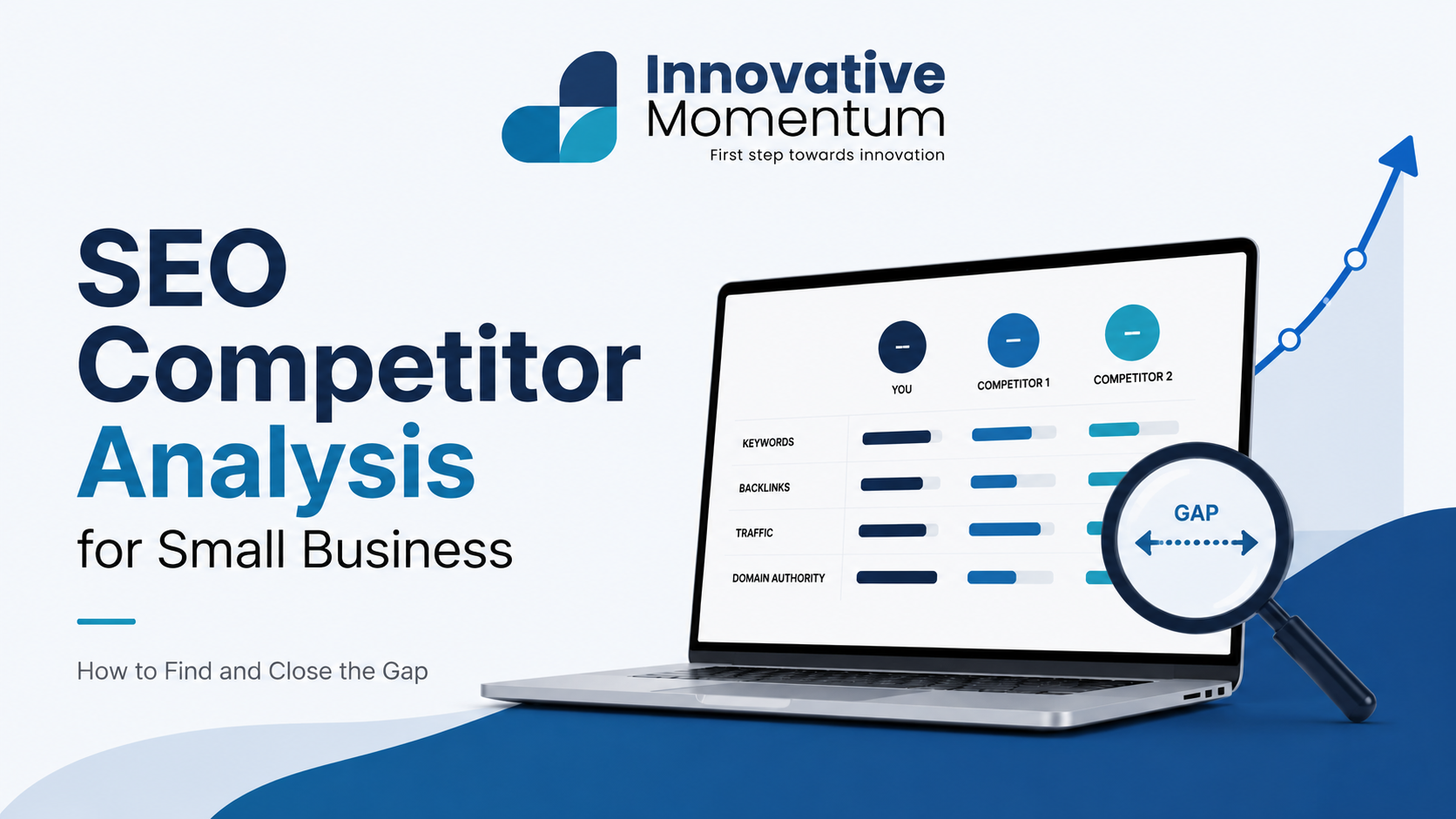
Most small businesses know who their competitors are. Few know what their competitors are doing in search that is actually working. SEO competitor analysis closes that gap — it tells you which keywords your competitors rank for that you do not, which pages attract the most of their traffic, and where their backlink authority comes from. That intelligence directly informs where you invest your SEO effort.
This guide covers how to run a practical SEO competitor analysis as a small business without paid tools being a prerequisite, and how to turn the findings into a prioritized action list.
Step 1: Identify Your Actual SEO Competitors
Your SEO competitors are not necessarily the same as your business competitors. An SEO competitor is any website that ranks on page 1 of Google for the queries you want to rank for. A national brand with a domain authority of 80 may be a business competitor but not a realistic SEO competitor for a local query — a local business ranking in position 3 for your target keyword is your real SEO competition.
To identify SEO competitors, take your five most important target keywords and search for each one. List every domain appearing in positions 1-10. The domains that appear most frequently across multiple searches are your primary SEO competitors — the sites you need to understand and systematically outperform.
Innovative Momentum
Want to implement these strategies for your business?
We help businesses grow with digital marketing, SEO, and AI-ready content strategies.
Separate your competitor list into two tiers: realistic targets (similar domain authority, similar business size) and aspirational targets (high-authority national players). Your strategy for catching a local competitor with 30 backlinks is fundamentally different from how you would approach a national directory with 10,000 backlinks. Focus first on tier one — these are the positions you can realistically close in 6-12 months.
Step 2: Analyze Their Top-Performing Content
Before investing in keywords or content, find what is already working for your competitors. Two free methods:
Using Google Search Operators
Type site:competitor.com into Google. This shows all indexed pages from that domain, roughly ordered by the pages Google considers most important. The top results are often their highest-traffic pages. Look at the page titles, URL structures, and content formats to understand what type of content performs in your niche.
Using Ahrefs Free or Semrush Free Tier
Both tools offer a limited free account. Ahrefs Webmaster Tools (free, verified domain only) shows your own performance. The free search bar on Ahrefs.com shows top pages and keyword data for any domain with limited results. For a small business running a focused analysis on 2-3 competitors, the free tier often provides enough data to identify the most valuable opportunities.
Step 3: Find the Keyword Gap
The keyword gap is the list of queries where competitors rank in positions 1-10 but your site does not appear at all. These are the topics your competitors have decided are worth targeting and where they have demonstrated ranking is achievable — a much more actionable starting point than keyword research from scratch.
Step 4: Audit Their On-Page SEO
For each competitor page ranking above yours for an important keyword, spend 10 minutes reading the page and checking these elements:
- Content depth: How thoroughly do they cover the topic? What questions do they answer that your page does not?
- Content format: Tables, step-by-step lists, comparison sections, and FAQs all perform well in AI Overviews. If their page uses structured formats and yours is prose, that is a gap to close.
- Internal linking: How many internal links do they have pointing to this page from other pages on their site? Internal links pass authority. A page receiving 12 internal links from high-traffic pages will outrank an equivalent page with 2 internal links in most markets.
- Schema markup: Use Google’s Rich Results Test on their URL to see what structured data they have. If they have LocalBusiness and Article schema and yours has none, that is a technical gap.
For detailed guidance on the on-page elements that affect your own pages, our technical SEO audit checklist covers the full set of checks to run on your own site.
Step 5: Analyze Their Backlink Profile
Backlinks — links from other websites pointing to your competitor’s domain — are one of the most significant ranking factors. A competitor with 50 high-quality backlinks from relevant sites will outrank a technically superior site with 5 backlinks in most competitive markets.
Ahrefs’ free site explorer (limited results) or Moz Link Explorer (10 free queries per month) show any domain’s top linking sites. For each competitor, identify:
- Which types of sites link to them (industry directories, local news, partner businesses, guest post placements)
- Whether any of those link sources would also link to you if you asked
- Whether they have backlinks from sites that might list both of you (local directories, trade associations, chamber of commerce)
Competitor backlink analysis often reveals the easiest link-building opportunities: if three of your competitors all have links from the same local business directory and you do not, that directory is a simple citation win.
Step 6: Check Their Technical SEO
Technical SEO is less visible than content but directly affects how well a site ranks for competitive keywords. Run a quick technical check on each competitor’s homepage using Google’s PageSpeed Insights and the Rich Results Test. Note:
- Page speed: If competitors consistently score below 50 on PageSpeed Insights mobile, page speed is an achievable competitive advantage in your market. Most small business sites are slow; being meaningfully faster is a real differentiator.
- Schema markup: A competitor with complete LocalBusiness, Organization, and Article schema will appear more prominently in AI Overviews than one without. If you implement schema and they have not, you gain a structural advantage in AI search citations.
- Mobile experience: Check each competitor’s site on your phone. Difficult navigation, tiny text, and non-functional contact forms are common on small business sites. A better mobile experience improves both rankings and conversion rate.
Step 7: Identify Their Content Gaps (Your Opportunity)
Competitor analysis is not only about matching what competitors do — it is also about finding what none of them do well. Read the top 5 ranking pages for your most important keywords and ask: what question do searchers in this space commonly have that none of these pages answer well?
Content that fills a genuine gap in existing search results tends to rank faster and earn more backlinks than content that tries to be a slightly better version of the same article. Original research, local data, detailed how-to guides with specific real-world examples, and comparison content that none of your competitors have produced are the formats most likely to earn links and rank from a low-authority starting position.
Building a Simple Competitor Tracking System
A one-page spreadsheet is sufficient for most small businesses. Columns: keyword, your current position, competitor A position, competitor B position, notes on gap, action and owner, target date. Update monthly. This gives you a concrete picture of where you are gaining ground and where you are losing it without requiring expensive rank tracking software.
Google Search Console’s Search Results report shows your own ranking data. For competitor positions, Google Search is still the most reliable free source — manual monthly checks on your ten most important keywords take under 30 minutes.
Our guide on local SEO for small businesses covers the full set of local signals — including the content signals that differentiate service area pages from thin competitor pages. For a competitor analysis specific to your market, contact Innovative Momentum.
Frequently Asked Questions
How often should I run a competitor analysis?
A full competitor analysis once per quarter is sufficient for most small businesses. Check your rankings for target keywords monthly — if a competitor gains significant ground on a keyword you have been building, investigate what changed before your next quarterly review.
Should I copy my competitors’ content strategy?
No. Competitor analysis tells you the minimum bar — what you need to match to be competitive. Copying exactly produces a duplicate that Google will not reward. Use competitor research to understand what works in your market, then produce content that is demonstrably more useful, more detailed, or more original than what already ranks.
What free tools are actually useful for competitor analysis?
Google Search (manual checks), Google’s Rich Results Test, PageSpeed Insights, and the free Ahrefs site search bar cover the fundamentals without cost. Ahrefs Webmaster Tools (free, your own domain only) gives detailed keyword data for your site. Moz Link Explorer provides 10 free lookups per month for competitor backlink data. These tools are sufficient for a quarterly competitive review for most small businesses.
AI Search Competitor Analysis
As AI Overviews take a growing share of search interactions, competitor analysis needs to extend beyond traditional ranking positions. A competitor that ranks position 5 in organic results but appears in every AI Overview for your target queries is winning more visibility than the ranking position suggests.
To audit AI search visibility: search your five most important keywords in Google and note which businesses appear in the AI Overview. These are the competitors that AI systems currently trust as authoritative sources on those topics. Examine their pages for the signals that drive AI citation: structured data (run the Rich Results Test), content format (tables, numbered steps, FAQ sections), and entity consistency (consistent NAP across GBP, website, and citations).
A competitor appearing in AI Overviews typically has strong schema markup, high-confidence entity data across multiple sources, and content that answers questions directly in a structured format. If none of your current competitors appear in AI Overviews for your target queries, that is an open opportunity to be the first credible source Google’s AI system cites. Our guide on how to get cited in ChatGPT and Perplexity covers the specific signals involved.
Turning Analysis Into a 90-Day Action Plan
Competitor analysis without action is market research. The output of a quarterly competitor review should be a ranked list of three to five specific actions ordered by expected impact, not a comprehensive audit that overwhelms the team. A useful format: the gap identified, the specific action required, the estimated effort (hours), and a target completion date within 90 days.
Prioritize by proximity to existing ranking position: a page ranking in position 8 for a keyword with 500 monthly searches is closer to a conversion than a page that does not appear on page 1 at all. Moving from position 8 to position 3 on an existing page is often faster and higher ROI than creating new content to rank for a new keyword. Use competitor analysis to identify which existing pages are closest to breaking into the top 3, and focus improvement effort there first.

Keep reading
Related insights
No comments yet. Be the first to share your thoughts.