
Key takeaway
Budget under $500/month gets you reporting and minor fixes. Real movement on competitive keywords requires $1,000 to $2,500/month sustained for 6 to 12 months. SEO is not a one-time project.
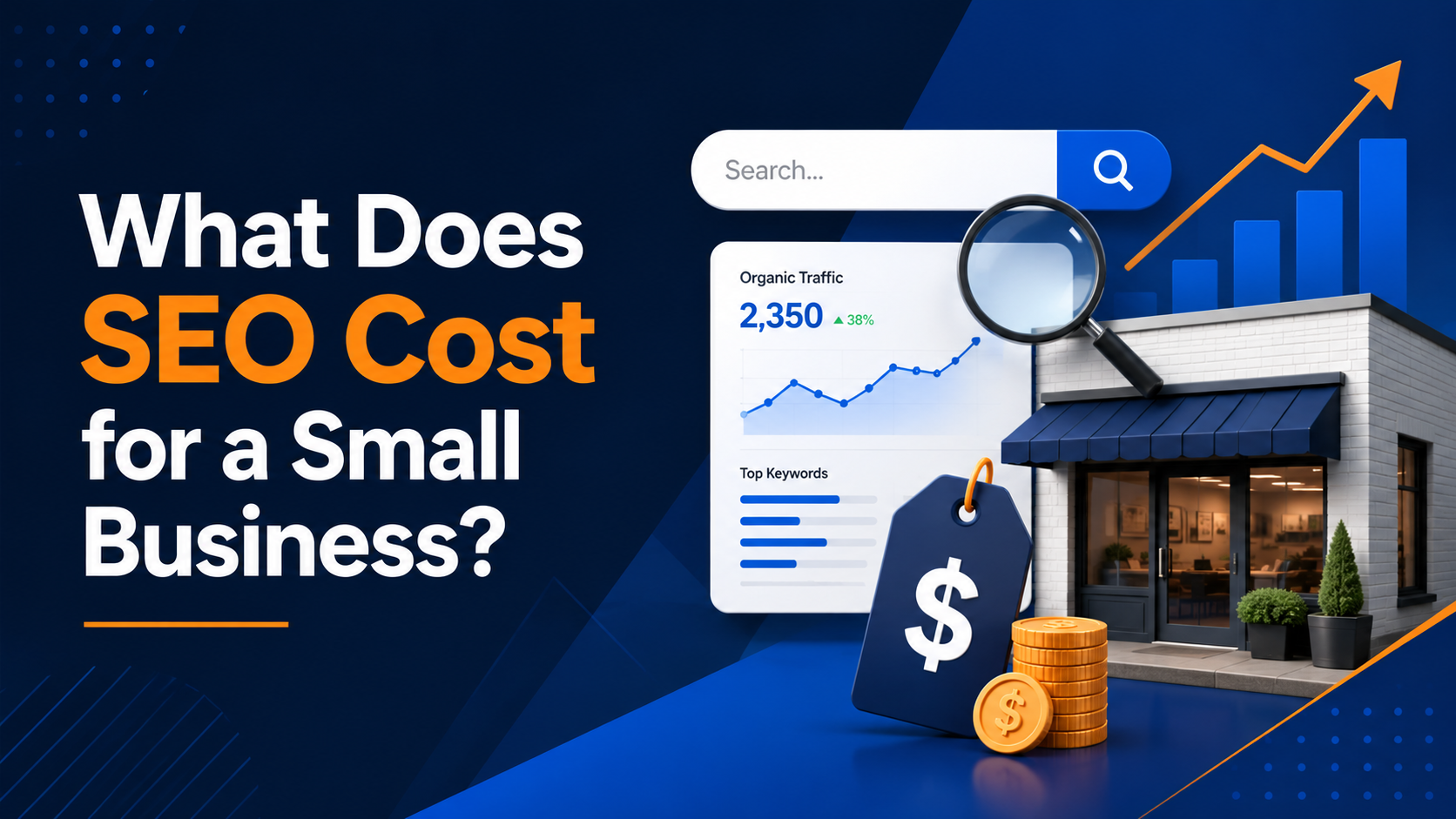
The Short Answer: What Does SEO Cost for a Small Business?
Most small businesses pay between $500 and $3,000 per month for ongoing SEO services from an agency or consultant. One-time projects — a technical audit, a site migration, or a new website optimized from scratch — typically run $1,500 to $8,000 depending on scope.
Those ranges are real, but they hide a lot of variation. A $500/month SEO retainer from a low-cost provider and a $500/month retainer from an experienced specialist are not the same product. Understanding what drives the difference — and what you’re actually buying at each price point — is what this guide is about.
Why Most Agencies Won’t Publish Their Prices
SEO pricing is notoriously opaque. Most agencies ask you to “contact us for a custom quote” rather than publishing a fee schedule. There are legitimate reasons for this — every client’s website, competitive landscape, and goals are different, and pricing without context is misleading. But there’s another reason: price transparency requires confidence in your positioning, and many agencies use vague pricing to avoid competitive pressure.
The result is that most small business owners go into their first SEO conversation with no benchmark. They don’t know if $800/month is a fair price or a rip-off, and they have no framework for evaluating the difference between two proposals that look similar on paper.
Innovative Momentum
Want to implement these strategies for your business?
We help businesses grow with digital marketing, SEO, and AI-ready content strategies.
This guide gives you that framework — actual price ranges, what they buy, what to push back on, and how to evaluate whether a proposal makes sense for your situation.
SEO Cost Breakdown: What Different Budgets Actually Buy
Here’s how the market segments in practice:
$300–$700/month
At this price point, you’re typically working with an offshore team, a reseller using white-label services, or a generalist who’s juggling 30+ clients. The deliverables usually include a handful of optimized blog posts per month, some basic on-page edits, and a monthly report. Technical SEO, link building, and serious competitive analysis are almost never included at this price.
This isn’t worthless — for a very new website with zero optimization, even basic work moves the needle. But expect slow progress and limited strategic depth. If your competitors are investing $2,000/month in SEO, $400/month probably won’t close the gap.
$800–$1,500/month
This is where you start seeing real strategic engagement. At this range, an experienced solo consultant or small agency can reasonably deliver: a proper keyword strategy, monthly content production (1-3 strong posts), technical fixes as they’re identified, some local citation work for service businesses, and reporting that’s tied to actual business metrics rather than vanity traffic numbers.
This is the realistic minimum for a competitive niche — healthcare, legal, home services, B2B software. Below this, you’re getting partial service.
$2,000–$5,000/month
Mid-market agency territory. At this level you should expect: dedicated account management, a structured content calendar with 4–8 pieces of content per month, active link building (not just citations — real editorial backlinks), technical SEO monitoring, and attribution reporting that connects SEO activity to leads and revenue. This is appropriate for businesses where a single customer is worth $5,000+ in lifetime value, or where organic traffic is a primary revenue channel.
$5,000+/month
Enterprise or aggressive growth mode. Appropriate for businesses competing in high-volume, high-value search categories. At this level you’re funding a full team: strategist, content writers, technical developer, link builder. Most small businesses don’t need this and won’t get proportional returns from it unless they’re already established and scaling hard.
One-Time SEO Project Costs
Not every SEO engagement is a monthly retainer. Here are the typical one-time projects and what they cost:
Technical SEO Audit: $500–$3,000
A real technical audit examines crawlability, indexation, site speed, structured data, internal linking, duplicate content, and mobile performance. A $500 audit is typically automated — a tool report with light commentary. A $2,000+ audit involves a human going through the site systematically and producing an actionable prioritized fix list. For small sites (under 50 pages), a $750–$1,200 audit from a qualified consultant is usually sufficient.
Keyword Research: $300–$1,500
Standalone keyword research — mapping the full opportunity for a site, including primary service terms, long-tail content targets, and competitor gap analysis — runs $300 for a basic deliverable to $1,500 for a comprehensive content strategy with volume, difficulty, and prioritization built in.
Content Strategy + First Articles: $1,000–$4,000
Some businesses need a one-time content strategy package to start: keyword mapping, a 6-12 month editorial calendar, and the first 4–6 articles produced. This one-time investment gives you a content program you can run in-house or hand to a writer, without paying for ongoing strategy every month.
Website SEO Setup (new site): $1,500–$5,000
Setting up a new WordPress site with proper SEO from the start — correct URL structure, schema markup, clean navigation, proper heading hierarchy, Google Search Console and GA4 integration, sitemap, and all on-page elements configured — adds $1,500–$3,000 to a web design project. Skipping this on a new site means retrofitting it later, which costs more.
SEO Subscriptions: A Different Pricing Model Worth Knowing
Beyond traditional agency retainers, the market has developed productized SEO subscriptions — flat monthly fees for a defined scope of work. These aren’t new, but the quality of the model has improved significantly. Rather than paying for an account manager’s time, you’re paying for a specific deliverable per month.
The subscription model works across different providers with fixed scope, transparent pricing, and no long-term contracts. For small businesses that want predictable costs and no need for custom strategy, this can be a better fit than a traditional retainer.
The tradeoff: subscription services are less flexible. If your site has technical problems or you’re in a particularly competitive niche, a productized subscription may not move the needle as fast as a dedicated consultant who can adjust the approach based on what’s working.
DIY vs Freelancer vs Agency: Total Cost Comparison
DIY SEO
Time cost: 5–15 hours/month. Tool cost: $100–$300/month (Semrush, Ahrefs, or an equivalent). Realistic outcome: meaningful improvement on long-tail keywords, good local SEO results for service businesses, slow but real progress on content. Works if you have the time to learn and execute consistently. Doesn’t work if SEO is a background task that gets deprioritized every time the business gets busy — which is most of the time.
Freelance SEO Consultant
Rate range: $75–$200/hour, or $500–$2,500/month on retainer. Best for businesses that need a strategic advisor rather than execution support — someone to tell you what to do and review your team’s work, rather than doing the work themselves. A good freelance SEO consultant at $150/hour billing 8 hours/month is actually more cost-effective than a $1,200/month retainer at an agency, if the consultant is genuinely senior.
Agency Retainer
Covers strategy, execution, and reporting in one. Appropriate when you don’t have internal resources to execute and need consistent output without managing individual freelancers. The risk: agencies with too many clients produce templated work. Ask specifically how many clients each person on your account manages. More than 15 clients per person is a red flag for attention.
What Makes SEO Pricing Vary So Much?
Four main factors drive price differences between providers:
Niche competitiveness: Ranking for “personal injury lawyer [city]” costs more to achieve than ranking for “CRM setup for nonprofits” because the competition is spending more. Competitive niches require more content, more backlinks, and more technical work to move rankings.
Site size and technical debt: A new 20-page WordPress site is cheaper to optimize than a 500-page ecommerce site with five years of accumulated technical issues. The scope of the problem directly affects the price.
Geographic vs national vs global targeting: Local SEO for a single city is significantly less expensive than national SEO for a competitive category. Many small businesses overpay because their agency is treating them like a national campaign when local SEO is all they need.
Content production included vs separate: Some agencies quote retainers that include content writing. Others quote strategy and optimization separately from content production. Comparing proposals requires understanding what’s included. A $1,500/month retainer that includes 4 blog posts is different from a $1,500/month retainer that doesn’t include content.
Red Flags in SEO Pricing
Watch out for these signs that a proposal isn’t what it appears:
- Guaranteed rankings: No one can guarantee a specific ranking. Google’s algorithm is outside any agency’s control. Guaranteed rankings are either misrepresented (ranking for terms with no search volume), or a setup for disappointment.
- Long-term contracts with vague deliverables: A 12-month contract is reasonable if the deliverables are specific. A 12-month contract for “SEO services” with no defined scope is a trap.
- Reporting that only shows traffic, not leads: Traffic that doesn’t convert is a vanity metric. Your SEO reporting should include lead submissions, phone calls, and other conversion actions, not just sessions and impressions.
- Pricing that’s significantly below market with no explanation: At $200–$300/month, an agency either has overseas labor at a scale that makes individual attention impossible, or the service is automated link building that will harm your site long-term.
What Innovative Momentum Charges
Our SEO services are positioned at the $800–$2,000/month range depending on scope, and include keyword strategy, on-page optimization, monthly content production, technical monitoring, and reporting tied to leads rather than traffic. We don’t do long-term lock-in contracts. If we’re not producing measurable progress within 90 days, you should find someone who does.
We also work on project basis for businesses that need a defined deliverable — an audit, a keyword map, a content strategy — without committing to a retainer. Contact us to discuss what your specific situation actually needs.
One note on pairing SEO with a well-built website: the best SEO investment is often rebuilding or optimizing the underlying site before adding content on top of it. Poor site structure, slow load times, and missing technical foundations cap how far content alone can take you. If you’re also considering a website project, we’ve published a practical guide on HubSpot website design for B2B teams that covers what to build before you scale content.
Paid Search vs SEO: Where Should Your Budget Go?
This question deserves its own article, but the short answer for small businesses: paid search (Google Ads) gives you immediate traffic but stops the moment you stop paying. SEO takes 3–12 months to show meaningful results but compounds over time. Most businesses that want sustainable growth need both — paid search to fill the pipeline while SEO builds, then SEO carrying more of the load as it matures.
For PPC specifically, the subscription model is increasingly viable. Fixed-fee managed PPC services let businesses predict ad management costs without the traditional percentage-of-spend agency model.
Budget allocation rule of thumb: if you’re spending $5,000/month on digital marketing, consider $2,000–$3,000 on paid search and $1,500–$2,000 on SEO for the first year. As SEO starts producing organic leads, you can reduce paid search spend proportionally.
Frequently Asked Questions About SEO Costs
Is cheap SEO worth it?
Below $500/month, most SEO services either produce little measurable output or rely on tactics (low-quality link building, thin content) that can damage your site’s long-term standing. If your budget is limited, it’s better to spend $300–$500 on a one-time keyword strategy and content plan, then execute it in-house, than to pay a low-cost provider for ongoing work that doesn’t compound.
How long before SEO shows results?
For a new website with no existing authority, budget 6–12 months before expecting significant organic traffic. For an established site with existing rankings, targeted optimization can show movement in 60–90 days. Local SEO for a service business in a mid-sized market can show meaningful results in 3–4 months with consistent effort.
Should I hire an in-house SEO or use an agency?
An in-house SEO specialist at $60,000–$90,000/year (plus tools) makes sense when organic search is a primary revenue channel and you need someone fully dedicated to your site. Below that threshold — or for businesses that need strategy and execution across multiple disciplines (SEO, content, CRM) — an agency or fractional arrangement is usually more cost-effective.
What’s included in a typical SEO retainer?
At minimum: monthly keyword tracking and reporting, on-page optimization recommendations, and some form of content support. Better retainers also include: active link building, technical SEO monitoring, competitor tracking, and conversion rate analysis. Ask any agency to give you a specific list of monthly deliverables, not just a description of their process.
How to Evaluate an SEO Proposal Before You Sign
Most small business owners evaluate SEO proposals based on price and the agency’s ability to present confidently. Neither is a reliable signal of quality. Here’s a more useful evaluation checklist:
Ask for specific examples of rankings achieved for comparable businesses. Not case studies with percentage improvements — actual examples of keywords ranked, starting position, ending position, and timeline. An agency that can’t show you this hasn’t done it recently enough to matter.
Ask who will actually work on your account. Many agencies sell at the senior level and deliver at the junior level. Find out if the strategist who presented to you is the person doing the work, or whether your account will be handed to a coordinator once you sign.
Ask how they’ll measure success. The right answer involves leads, form submissions, phone calls, and revenue attribution — not just organic sessions. An agency that leads with traffic metrics is optimizing for the wrong thing.
Ask what happens if results don’t materialize. The honest answer is that SEO takes time and there are no guarantees. An agency that guarantees specific outcomes in a specific timeframe is misrepresenting the reality of how search algorithms work. What you want to hear is a clear plan, honest timelines, and what they’ll change if the initial approach isn’t working.
Ask about reporting cadence and format. Monthly reporting is standard. Anything less frequent means you’re flying blind between check-ins. Ask to see a sample report — vague reports with lots of screenshots and no analysis are a signal that the agency is filling a template rather than thinking about your specific situation.
The Real Cost of Not Doing SEO
The framing of “how much does SEO cost” focuses on expense rather than return. The more useful question is: what’s the cost of not having organic search traffic?
For a business that acquires customers through its website, every month without SEO investment is a month where competitors are building domain authority, ranking for the terms your prospects are searching, and acquiring customers you could have had. The compounding nature of SEO means that starting later is progressively more expensive to overcome.
A rough way to think about it: if a single customer is worth $3,000 in revenue, and SEO can realistically generate 2–4 qualified leads per month after 6 months of investment, the return on a $1,200/month SEO retainer is measurable within a year. For most businesses, that math works. The question isn’t whether to invest in SEO — it’s finding a provider and price point that fits your timeline and budget.
Bottom Line: What to Budget
For most small businesses starting SEO from a limited base:
- Month 1–2: Invest in a proper audit and keyword strategy ($800–$1,500 one-time) before committing to a retainer. Understand your opportunities before paying for execution.
- Month 3–12: $800–$1,500/month retainer that includes content production and technical monitoring. Expect to see ranking movement in months 4–6, meaningful traffic in months 6–9.
- Year 2+: Reassess scope. If the content engine is working and technical issues are resolved, you may be able to reduce retainer spend and bring content production in-house while keeping strategy support.
If your budget is genuinely limited to under $500/month, focus it on a one-time content strategy and execute in-house rather than spreading thin resources across a low-quality ongoing retainer. Consistent, specific content published at your own pace will outperform a $400/month retainer that produces generic posts every month.

Keep reading
Related insights

No comments yet. Be the first to share your thoughts.