
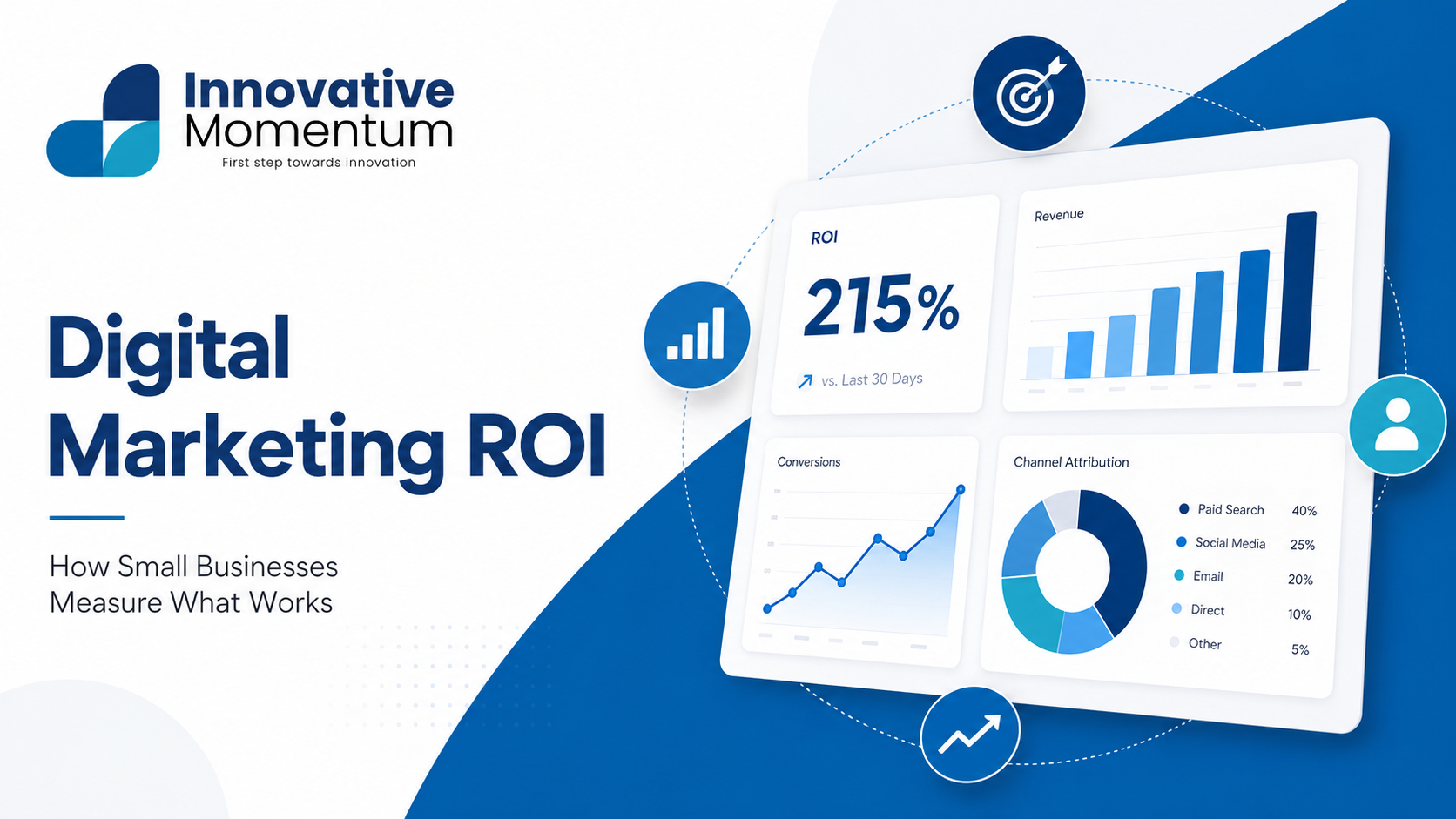
Key takeaway
The most important digital marketing ROI metrics are cost per lead, cost per acquisition, and customer lifetime value — track these three and you will always know which channels deserve more budget.
Most small businesses cannot clearly answer the question “which marketing activities are actually making us money?” They track spend across channels but cannot trace specific revenue to specific campaigns. This ambiguity leads to two predictable outcomes: either marketing budgets get cut because value is invisible, or ineffective spend continues because no one can demonstrate it is not working. Measuring digital marketing ROI is not a data science project — it is a practical business discipline that any small business can implement with tools that cost nothing.
This guide covers the framework for measuring marketing ROI across channels, which tools to use, how to set up tracking correctly, and how to use the data to make better allocation decisions.
What ROI Measurement Actually Requires
Measuring marketing ROI requires three things: conversion tracking (knowing when and where conversions happen), attribution (knowing which marketing activities caused the conversion), and value assignment (knowing what each conversion is worth). All three are required. Conversion tracking without attribution cannot tell you which channels to invest more in. Attribution without value assignment cannot calculate ROI. Most small business analytics setups have conversion tracking but weak or no attribution, and rarely include value assignment.
Conversion types to track for a service business:
Innovative Momentum
Want to implement these strategies for your business?
We help businesses grow with digital marketing, SEO, and AI-ready content strategies.
- Contact form submissions
- Phone calls from the website (click-to-call events)
- Online bookings or quote requests
- Email list sign-ups (with lead value estimate from conversion rate to client)
- Live chat conversations (for businesses using chat)
Assign a monetary value to each conversion type. If your average client is worth £3,000 and 10% of qualified enquiries become clients, each enquiry is worth approximately £300. This value feeds the ROI calculation for each channel.
Setting Up Tracking in Google Analytics 4
GA4 is the foundation of digital marketing measurement for most small businesses. The essential setup: configure conversion events for each conversion type above, and ensure that each event has the source/medium data attached (where did this visitor come from before converting?). Our guide on Google Search Console for small businesses covers the Search Console connection, and the connection between Search Console and GA4 enables keyword-level attribution for organic search conversions.
For all channels other than organic search and direct traffic, UTM parameters are essential for attribution. Every link you share — paid ads, email campaigns, social media posts, partner websites — should include UTM parameters that GA4 uses to identify the source. Without UTMs, most of this traffic appears as “Direct” in GA4, making channel-level attribution impossible.
UTM structure example: `https://yoursite.com/contact/?utm_source=linkedin&utm_medium=social&utm_campaign=q3-b2b-campaign`. When this link is clicked and the visitor converts, GA4 records the conversion with LinkedIn social as the source — you can see both the conversion and its origin.
Measuring SEO ROI
SEO ROI is calculated over a longer time horizon than paid channels. The cost is ongoing (agency retainer or time investment), but the value compounds: content created today continues attracting organic traffic for years. The calculation:
- Monthly organic traffic from GA4
- Conversion rate of organic traffic (GA4 conversions / organic sessions)
- Monthly organic conversions = organic traffic x conversion rate
- Monthly organic lead value = organic conversions x lead value
- Monthly SEO ROI = (organic lead value – SEO cost) / SEO cost x 100
SEO ROI typically turns positive 6-12 months into a program and continues improving as content accumulates and authority builds. Compare your calculation against the SEO cost guide to understand whether your investment is appropriately sized relative to the potential return in your market.
Measuring Content Marketing ROI
Content marketing ROI is the most difficult to calculate because content contributes to multiple conversion paths simultaneously. A blog post that ranks organically, gets shared on social media, is linked in an email newsletter, and is referenced by a partner site touches multiple attribution touchpoints for a single visitor. Multi-touch attribution models — which assign credit across all touchpoints in a conversion path rather than only the first or last — give a more accurate picture of content’s contribution.
Practical content ROI tracking: in GA4, look at which blog posts and content pages appear in the conversion paths of your converted users (available in the Explore section). Content that consistently appears early in conversion paths — even when the final conversion comes through a different channel — is building value that last-click attribution misses. Our guide on content marketing strategy covers content performance measurement in more detail.
Measuring Email Marketing ROI
Email marketing ROI is the most measurable of all channels when tracked correctly. UTM-tagged links in every email campaign allow GA4 to attribute website sessions and conversions to specific email sends. Calculate:
- Revenue attributed to email (conversions with utm_medium=email x lead value)
- Cost of email (tool subscription + time to create)
- ROI = (revenue – cost) / cost x 100
Average email marketing ROI figures typically cited are extremely high (30:1 or more) because the cost is very low. The more relevant metric for decision-making is the absolute revenue generated, which tells you whether to invest more time in email list building and campaign frequency.
Measuring Social Media ROI
Social media ROI is the most contested measurement in digital marketing. Direct conversions from social media (tracked via UTM parameters) undercount social’s true contribution because many social visitors return later through organic search or direct traffic — and that return visit gets the credit. The realistic approach: track direct social conversions, but also track social’s contribution to brand awareness through reach, follower growth, and assisted conversions visible in GA4’s attribution reports.
For social media ROI, distinguish between organic and paid. Paid social ROI is measurable through the ad platform’s conversion tracking (Meta Ads Manager, LinkedIn Campaign Manager) and GA4. Organic social ROI requires the longer-term perspective of brand value and pipeline influence rather than direct, immediate conversion attribution.
Building a Simple ROI Dashboard
A monthly marketing ROI report does not need to be complex. The information needed for good allocation decisions:
This simple view makes allocation decisions clear: increase investment in the highest-ROI channels, investigate channels where ROI is negative or unclear, and stop investing in channels that consistently fail to generate measurable return. For the broader digital marketing strategy context, see our small business digital marketing strategy guide. For a marketing measurement audit for your business, contact Innovative Momentum.
Frequently Asked Questions
How do I measure ROI from SEO before conversions come in?
Early in an SEO program, before conversion volume is sufficient for statistical conclusions, use leading indicators: organic traffic growth, keyword ranking improvements, and organic click-through rate trends in Google Search Console. These indicate whether the SEO investment is building momentum even before conversions become consistently measurable. Set milestone-based expectations with your SEO provider: specific ranking improvements or traffic targets at 3, 6, and 12 months.
Is last-click attribution accurate enough for small business decisions?
Last-click attribution (giving all credit to the final touchpoint before conversion) is a reasonable starting point for simple journeys but misrepresents multi-touch paths. For small businesses, the most common distortion is that SEO and content marketing appear less valuable because they often appear early in conversion paths rather than at the last click. A customer who first finds you via a blog post, then returns weeks later via a Google Ads click, generates a conversion attributed entirely to Google Ads — even though the blog post initiated the relationship. Awareness of this bias, rather than complex attribution modeling, is sufficient for most small business marketing decisions.
What should I do if I cannot measure ROI for a specific channel?
Unmeasured channels are not necessarily ineffective — they may be generating value that your tracking cannot capture. The practical response: invest in better tracking (UTM parameters, conversion events, call tracking), then allow 90 days for data to accumulate before making channel allocation decisions based on the new data. If after 90 days a channel still shows no measurable contribution, reduce investment and reallocate to channels where ROI is demonstrable.
Customer Lifetime Value and Marketing ROI
Single-conversion ROI calculations understate the true value of marketing for businesses with repeat customers or referral-based growth. A new client worth £2,000 on their first project may be worth £8,000 in lifetime revenue if they return for additional projects and refer others. Customer Lifetime Value (CLV) is the total revenue you can expect from a customer relationship, including repeat purchases and referrals.
Calculating CLV for a service business:
- Average transaction value: £X per project
- Average number of transactions per year: Y
- Average customer lifetime (years): Z
- CLV = X × Y × Z
When CLV is incorporated into ROI calculations, marketing channels that generate loyal, high-retention customers appear more valuable than channels that attract one-time buyers at similar acquisition cost. A channel generating clients who average 3 years of relationship is worth more than a channel generating clients who average 1 year, even at identical initial acquisition cost. Tracking client source (which marketing channel brought each client) and measuring average lifetime value by source gives you the highest-fidelity ROI picture available.
Building a Marketing Dashboard Small Businesses Will Actually Use
The best marketing dashboard is one that gets reviewed monthly and informs decisions. A complex 30-metric dashboard is less useful than a simple 8-metric dashboard that you review consistently. For most small businesses, a monthly review should cover:
- Total conversions by channel (organic, paid, direct, email, referral)
- Cost per conversion by channel (for paid channels)
- Organic traffic trend (month-over-month and year-over-year)
- Email list size and growth rate
- Average monthly revenue and its trend
- New clients and their acquisition source
Google Looker Studio (formerly Data Studio) is a free tool that connects GA4, Search Console, and other data sources into a single visual dashboard. A basic dashboard can be built in 2-3 hours and maintained automatically. For the broader digital marketing framework that this measurement system supports, our digital marketing strategy guide covers how to connect measurement to planning and investment decisions. For help setting up a marketing measurement system for your business, contact Innovative Momentum.
Attribution Modelling Beyond Last Click
GA4’s default attribution model is data-driven attribution (DDA) for accounts with sufficient conversion volume, and last-click for smaller accounts. Data-driven attribution uses machine learning to assign fractional credit to each touchpoint in a conversion path based on its observed contribution — this gives a more accurate picture than last-click, particularly for channels like SEO and content marketing that influence early-stage decision-making but are rarely the last touchpoint before a form submission.
For small businesses without sufficient conversion volume for DDA, the practical alternative is comparing first-click and last-click reports side by side. First-click attribution shows which channels initiate relationships (strong channels for awareness campaigns); last-click shows which channels close them (strong channels for bottom-of-funnel campaigns). Channels that appear valuable under first-click but not last-click — content, social media, display advertising — are building pipeline that other channels close. This comparison prevents both over-cutting awareness channels (because they appear not to convert) and over-investing in bottom-of-funnel channels (because they appear to convert everything).
For the SEO investment side of the ROI equation, our SEO cost guide covers realistic budget expectations and ROI timelines to benchmark your own measurement. For a marketing measurement audit, contact Innovative Momentum.
Phone Call Tracking for Service Businesses
Phone calls are the most common conversion type for local service businesses — and the most commonly under-tracked. If your Google Ads or organic traffic generates phone calls that are not recorded as GA4 conversions, your ROI calculations are systematically understating the return from those channels. Call tracking solutions (CallRail, ResponseTap, or Google Ads call extensions with conversion tracking) assign unique phone numbers to specific traffic sources, allowing GA4 to attribute phone call conversions to the channel that generated them.
For a service business where phone enquiries represent 50-70% of conversions, adding call tracking can fundamentally change which channels appear most valuable in ROI analysis. A channel that appeared to generate only 3 form submissions per month may be generating an additional 8 phone calls — changing its ROI from marginal to compelling. For the full digital marketing strategy framework, our small business digital marketing strategy guide covers how to build a joined-up measurement approach across all channels.
For tailored marketing ROI measurement, contact Innovative Momentum.

Keep reading
Related insights

No comments yet. Be the first to share your thoughts.