
Key takeaway
The three pillars of reputation management: actively asking for reviews after every job, responding to negative feedback within 24 hours, and keeping your Google Business Profile fully updated.
Your online reputation is what potential customers find when they search your business name. Unlike traditional word-of-mouth reputation that spread slowly through personal networks, online reputation is permanent, public, and influential at scale. A single one-star review visible to thousands of searchers, or a negative article ranking in your brand search results, can cost you clients who never contact you to give you a chance to respond.
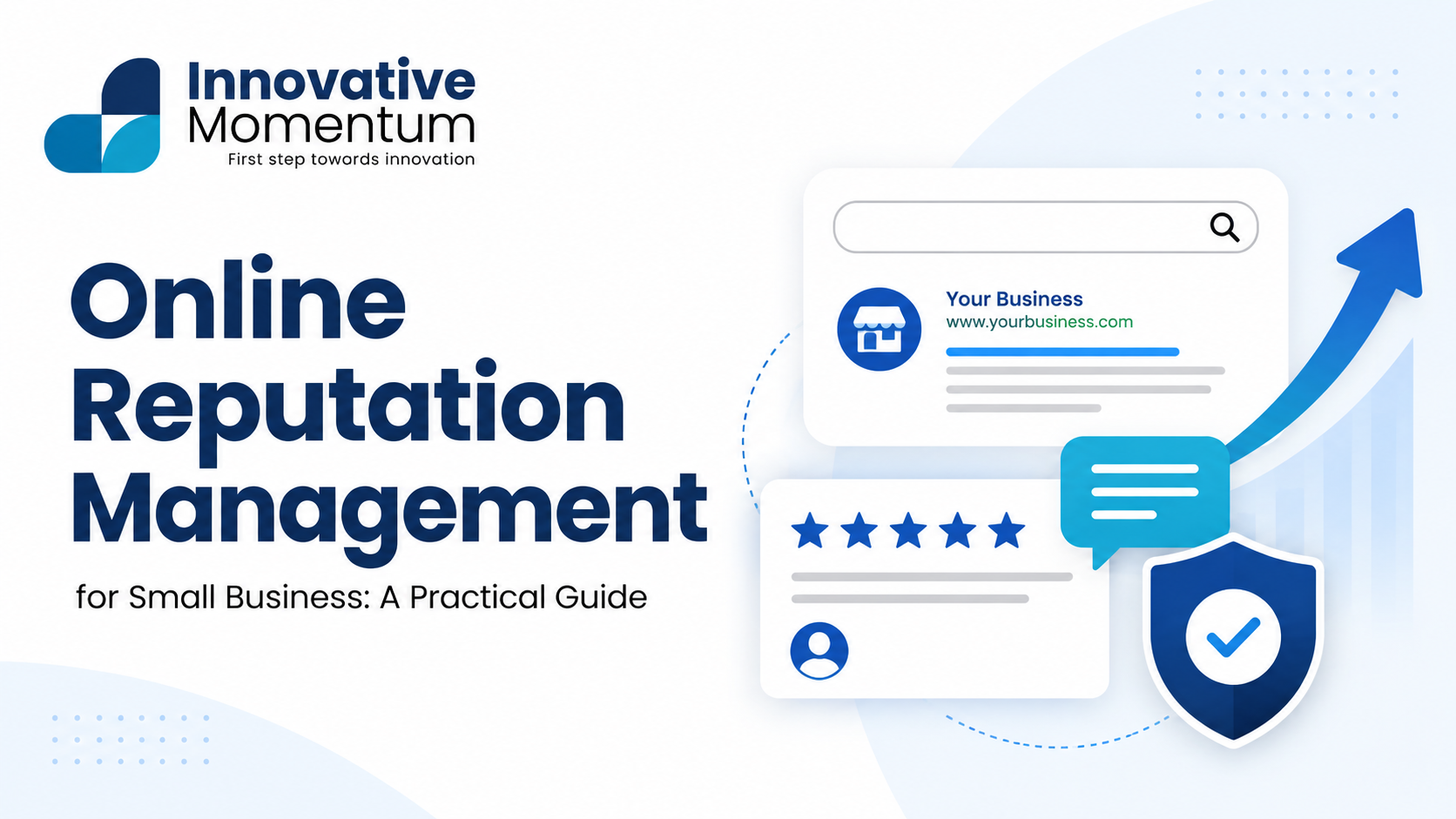
Online reputation management (ORM) for small businesses is the systematic process of monitoring, building, and protecting how your business appears online — primarily through search results, review platforms, and social media. This guide covers the practical approach to ORM for small businesses that do not have a dedicated PR or communications team.
Why Online Reputation Matters for SEO
Your online reputation and your search rankings are increasingly connected. Google’s E-E-A-T framework (Experience, Expertise, Authoritativeness, Trustworthiness) explicitly values trust signals — and reviews, mentions, and brand signals are evidence of trustworthiness that Google weighs in ranking decisions. A business with hundreds of positive reviews across multiple platforms appears more authoritative than an identical business with no reviews.
For local service businesses, reviews have a particularly direct impact on local search rankings. Google’s local ranking algorithm uses review quantity, review quality (star rating), and review recency as ranking factors for Google Business Profile visibility. A business with 50 five-star reviews consistently outperforms equally-optimized competitors with 10 reviews. Our guide on local SEO for small businesses covers how Google Business Profile optimization and review management work together as a local ranking strategy, and our E-E-A-T guide for small businesses covers the broader trust signals that affect Google’s quality assessment.
Innovative Momentum
Want to implement these strategies for your business?
We help businesses grow with digital marketing, SEO, and AI-ready content strategies.
Monitoring Your Online Reputation
You cannot manage what you do not know about. Set up monitoring systems that alert you when your business is mentioned online:
- Google Alerts: Free, easy to set up. Create alerts for your business name, the business owner’s name, and common misspellings. You will receive email notifications when new content containing these terms is indexed by Google.
- Review platform monitoring: Check your Google Business Profile, Facebook reviews, Trustpilot, and any industry-specific review platforms (Checkatrade for trades, Houzz for interior designers, etc.) at least weekly. Most platforms have notification settings — enable email alerts for new reviews.
- Social media mentions: Set up saved searches in Hootsuite, Sprout Social, or the native search function of each platform for your business name and common variations. Social mentions often precede formal reviews — they are early warning signals for both positive and negative sentiment.
Building a Positive Review Profile
The best ORM strategy is proactive: building such a strong foundation of positive reviews that isolated negative ones do not materially affect your overall profile. A business with 200 reviews averaging 4.8 stars is not significantly damaged by one 2-star review. A business with 8 reviews is damaged significantly by the same review.
The systematic approach to building reviews:
- Ask within 24-48 hours of a positive interaction, when the experience is fresh and the customer is most likely to act.
- Make it frictionless: provide a direct link to your Google review page (available in Google Business Profile settings). Every additional step between intent and review reduces completion rate.
- Ask in person for local services — a brief verbal ask followed by a text with the link outperforms email alone.
- Make it a team habit: if you have staff interacting with customers, train them to ask as standard practice after positive jobs.
Our guide on how to get more Google reviews covers the complete system, including review request templates, timing strategies, and how to respond to negative reviews in a way that mitigates their impact.
Responding to Negative Reviews
How you respond to negative reviews matters as much as the reviews themselves. Research from BrightLocal shows that 89% of consumers read business responses to reviews — they are not just evaluating the complaint but also how you handle it. A professional, empathetic response to a negative review demonstrates customer service quality and shows prospective customers that you take concerns seriously.
Framework for responding to negative reviews:
- Acknowledge without admitting fault prematurely: “Thank you for taking the time to leave feedback. I’m sorry to hear your experience did not meet your expectations.”
- Take it offline: “I would like to understand what happened and make this right. Please contact me directly at your email so we can resolve this.”
- Do not argue or become defensive: Every response is visible to all future readers. A defensive, argumentative response is more damaging than the original negative review.
- Be brief: A short, professional response is more effective than a lengthy defence. Prospective customers will read both the review and your response; keep your response focused and non-defensive.
For reviews that are factually inaccurate or violate platform policies (competitors leaving fake negative reviews, reviews from people who were never customers), most platforms have a flagging process for removal requests. Document the evidence before flagging.
Managing Negative Search Results
For most small businesses, reputation management is primarily about reviews. But if negative news articles, forum posts, or social media content ranks prominently in searches for your business name, a different approach is needed: creating and optimizing positive content to rank above the negative content.
Strategies for suppressing negative search results:
- Create and optimize your Google Business Profile so it appears prominently in branded searches.
- Build out social media profiles on major platforms (LinkedIn company page, Facebook Business Page) — these often rank on the first page for brand name searches.
- Publish authoritative content (press releases, industry articles, guest posts on reputable sites) with your business name to create additional positive results.
- Build a review profile on multiple platforms — Trustpilot, Clutch, or industry directories — that rank in brand searches.
Content suppression is a long-term process. Negative search results that have existed for years and have accumulated backlinks are difficult to displace quickly. Starting proactively — building a strong positive online presence before anything negative appears — is far more effective than reacting after the fact.
Review Platforms Beyond Google
Google is the priority platform for most small businesses, but the relevant review platforms depend on your industry. Service trades (plumbers, electricians, landscapers): Checkatrade, TrustATrader. Professional services (accountants, solicitors): VouchedFor, ReviewSolicitors. Design and creative services: Clutch, Houzz. B2B software and services: G2, Capterra.
Maintaining consistent, accurate business information (NAP: Name, Address, Phone) across all platforms is both a local SEO factor and a trust signal. Inconsistent information across directories signals unreliability. Our guide on Google Business Profile optimization covers the NAP consistency principle in the context of local search.
For help developing an ORM strategy for your small business, contact Innovative Momentum for a brand audit and reputation management plan.
Frequently Asked Questions
Can I remove a negative Google review?
You can request removal of reviews that violate Google’s review policies: fake reviews, reviews from competitors, reviews containing prohibited content, or reviews about a different business. Google does not remove negative reviews simply because they are unflattering or you disagree with them. Flag the review in Google Business Profile, provide documentation if available, and allow 5-7 days for Google’s review team to assess. Persistent false reviews can be escalated through Google’s Business Profile Help Center.
How many reviews do I need for online reputation to help my rankings?
There is no specific threshold, but the effect compounds as quantity grows. Going from 5 to 20 reviews with a 4.5+ average has a significant visible impact on credibility and local rankings. Going from 50 to 100 reviews has a smaller incremental impact. The most important factor is maintaining a consistent rating above 4.0 — a high review count with a 3.2 average is actively harmful, as it provides evidence of widespread dissatisfaction.
Should I respond to positive reviews too?
Yes. Responding to positive reviews serves three purposes: it shows the reviewer that their feedback was seen and appreciated (increasing loyalty), it demonstrates to prospective customers that you are attentive and engaged, and it provides Google with fresh, relevant activity on your Business Profile listing. Responses to positive reviews can be brief — a personalized acknowledgment of the specific work mentioned in the review is more effective than a generic “Thanks for your review!”
Crisis Reputation Management
A reputational crisis — a viral negative review, a complaint shared widely on social media, a news article about a business failure, or a public dispute — requires a different approach from routine reputation management. The speed and transparency of your response determines whether a crisis is contained or amplified.
Crisis response principles for small businesses:
- Respond quickly, but not reactively: A response within 24-48 hours is essential for credibility. However, a reactive, defensive, or emotional response during the first hours of a crisis typically makes the situation worse. Take time to understand what happened before communicating publicly.
- Acknowledge, do not minimize: “We understand that some customers have had a negative experience and we take this very seriously” is a stronger opening than explaining why the complaints are exaggerated. Customers and observers evaluate how seriously you take concerns, not whether you successfully defend yourself.
- Take accountability for what you control: If a mistake was made on your side, say so clearly. Accountability is credibility-building when followed by a specific plan to prevent recurrence. Deflecting responsibility to circumstances or customer error in a public forum further damages trust.
- Move the resolution offline: Provide a specific contact route (direct email to you or a senior person) and explicitly invite the complainant to reach out. This demonstrates seriousness, removes the public back-and-forth, and creates an opportunity to resolve the underlying issue.
After a crisis is resolved, the reputation building work continues. A business that handles a crisis professionally — acknowledging the issue, resolving it, and communicating transparently — often emerges with stronger reputation than before the crisis, because the response demonstrated values that most businesses never need to make visible.
Online PR and Proactive Brand Building
Online PR — earning mentions, links, and coverage from authoritative websites — is the most durable long-term reputation management strategy. Coverage in industry publications, local news sites, or authoritative directories creates positive content that ranks in brand searches and builds the digital footprint that makes a business appear established and credible.
Small business online PR tactics that work without a dedicated PR team: contribute expert quotes to journalists (via services like Help a Reporter Out, or Sourcebottle in Australia/UK) who regularly need expert sources for articles; sponsor or speak at local industry events that generate coverage on event websites; write guest articles for industry publications or local business media. Each piece of earned coverage creates a citation of your brand on an authoritative site — reinforcing both reputation and SEO authority simultaneously. For the SEO authority connection, our guide on link building for small businesses covers how earned media and digital PR function as link-building strategies with dual reputation and SEO benefit.
Schema Markup and Online Reputation
Schema markup contributes to online reputation management by giving Google structured, authoritative information about your business directly from your own website — reducing reliance on third-party sources for basic business facts. LocalBusiness schema, ReviewSnippet schema (when legitimately aggregated via a third-party review platform), and Organization schema with sameAs properties linking to your social profiles all help Google build a complete, accurate knowledge graph for your business. Our guide on schema markup for small businesses covers the specific markup types and implementation in WordPress. For link building as part of online PR, our link building guide covers how earned media and authority signals reinforce both reputation and search rankings simultaneously. For a comprehensive online reputation audit and management plan, contact Innovative Momentum.
Review Velocity: Why Consistency Matters More Than Volume
A burst of 50 reviews followed by silence for 18 months looks suspicious to both Google and potential customers. Review recency is a ranking factor for local SEO — Google wants evidence that the business is actively serving customers now, not just that it did well in 2022. A consistent cadence of 2-5 new reviews per month is more valuable than 50 reviews acquired in a single campaign. Build review generation into the regular post-service workflow rather than running periodic campaigns. For a full local reputation strategy including reviews and local search visibility, our local SEO guide covers the integrated approach.

Keep reading
Related insights
No comments yet. Be the first to share your thoughts.