
Key takeaway
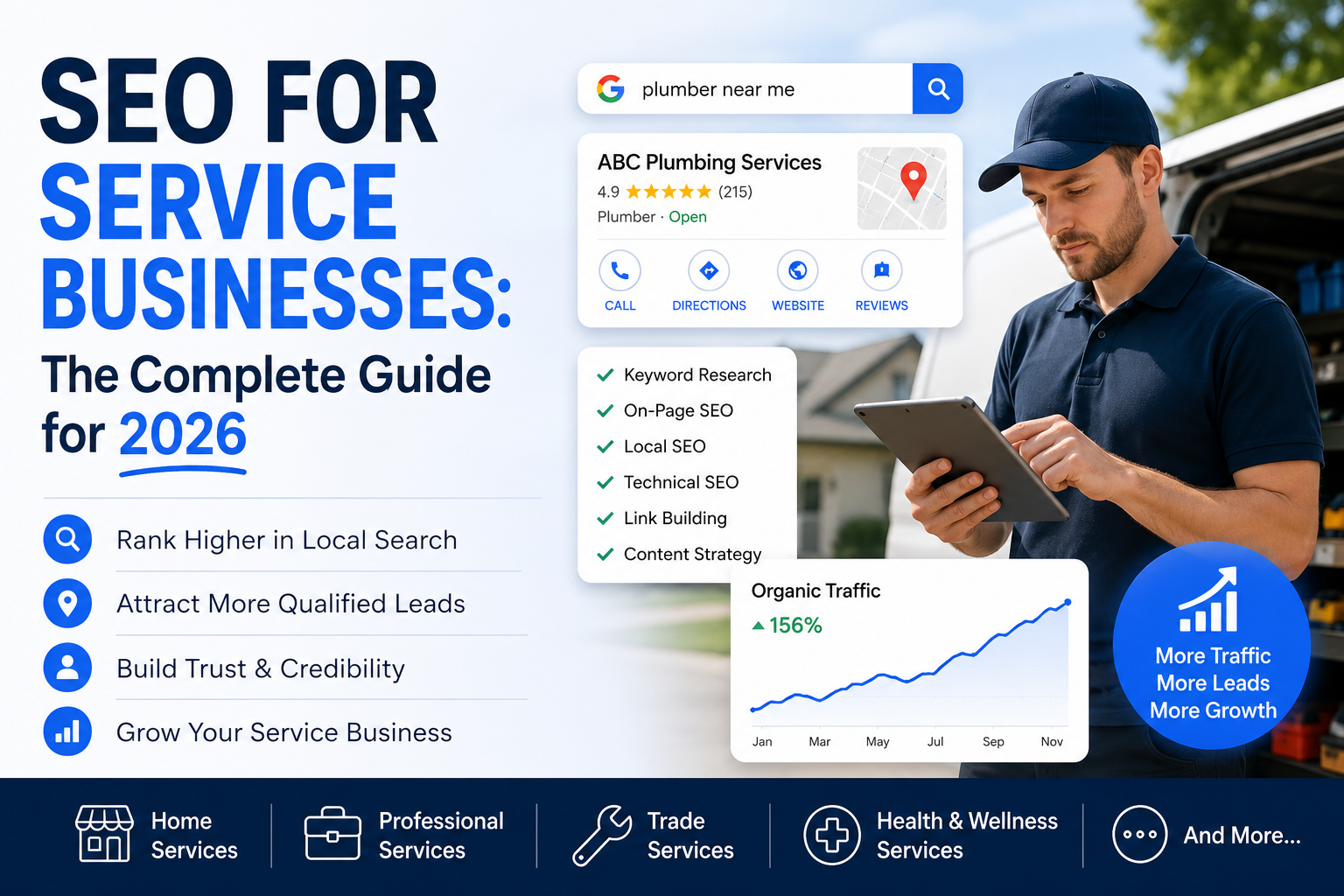
The highest-ROI SEO moves for service businesses are local citation consistency, service-specific landing pages, and Google Business Profile optimisation — not expensive link-building campaigns.
Service-based businesses — plumbers, HVAC contractors, solicitors, accountants, dentists — operate in the most competitive corner of local search. The businesses that consistently rank are not necessarily the best in their area. They have done the SEO fundamentals more thoroughly than everyone else.
This guide covers the SEO strategies that move the needle for service businesses in 2026, from Google Business Profile to content architecture to the technical signals that determine where you appear in map pack and organic results.
Why Service Business SEO Is Different
Service businesses optimize for phone calls and booked appointments, not page views. Three structural differences shape how service business SEO works:
- Local intent dominates: 46% of all Google searches include local intent, according to Google’s own data. For service businesses, the figure is far higher — nearly every commercial query for a plumber or solicitor includes explicit or implicit location intent.
- Reviews are a direct ranking factor: BrightLocal’s 2025 Local Consumer Review Survey found 98% of consumers use the internet to find local businesses, and 87% read reviews before making contact. Google treats review volume, recency, and rating as local ranking signals.
- Google Business Profile outweighs the website for local queries: The map pack captures more clicks than organic listings for “near me” and city-qualified queries. Your GBP is not secondary to your website — for most service businesses it is the primary search presence.
Google Business Profile: The Baseline You Cannot Skip
A complete, accurate, actively managed GBP is the single highest-ROI action for most service businesses. The elements that drive map pack rankings:
Innovative Momentum
Want to implement these strategies for your business?
We help businesses grow with digital marketing, SEO, and AI-ready content strategies.
Service Area Pages vs. Single Location Pages
A single “areas we serve” page with a list of towns does not rank. Google needs a dedicated page per location. A plumber serving five cities needs five location pages — each with specific content about the area, local landmarks, and genuinely useful local information. Swapping city names on a copied template produces near-duplicate content that Google will not rank.
Minimum viable location page: 400 words of genuinely location-specific content, title tag formatted as “your service in your city | your business”, LocalBusiness schema with areaServed, and a phone number plus contact form above the fold.
For the technical signals that support your location pages, our technical SEO audit checklist covers the crawlability and indexing checks that affect how Google processes them.
On-Page SEO for Service Pages
Every service page needs to target a specific commercial keyword — not just the service name, but the intent-qualified version. “Emergency plumber” and “boiler installation cost” are fundamentally different queries with different buyer intent. Structure your service pages around one primary keyword and two or three closely related terms rather than trying to rank a single page for everything.
The on-page elements that matter most for service pages:
- Title tag: Lead with the keyword, include the city for local pages. “Boiler Installation Manchester | your business” performs better than “your business | Plumbing Services”.
- H1: Match the search intent precisely. A visitor arriving from “emergency boiler repair” expects to see that phrase prominently, not a generic “Our Services” heading.
- Above-the-fold CTA: Phone number and a contact form or booking link within the first viewport on mobile. Visitors from commercial queries are ready to act — do not make them scroll.
- Trust signals on the page: License numbers, insurance details, years in business, trade associations, and case study links all strengthen E-E-A-T on service pages. Google evaluates whether the page demonstrates genuine expertise, not keyword repetition.
Citation Building
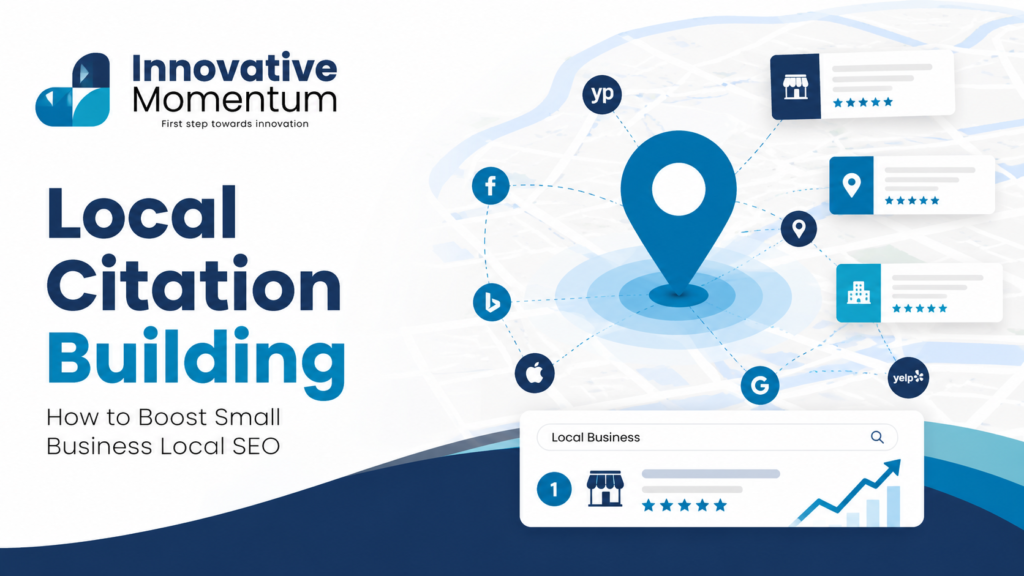
Citations are mentions of your business name, address, and phone number on other websites. They are one of the three primary local ranking factors alongside GBP signals and website authority. Consistent citations across authoritative directories send a strong confirmation signal to Google that your business is legitimate and located where you say it is.
Priority citation sources for UK service businesses: Yell.com, Checkatrade, Trustpilot, Thomson Local, Yelp UK, FreeIndex, and industry-specific directories (Gas Safe Register for plumbers, SRA for solicitors). For US businesses: Yelp, Angi, HomeAdvisor, Houzz, Better Business Bureau, and Manta.
Every citation must use exactly the same business name format, address, and phone number as your GBP and website. “Smith Plumbing Ltd” and “Smith Plumbing” are different entities in Google’s eyes — inconsistency creates conflicting signals that suppress local rankings.
Content Strategy for Service Businesses
E-E-A-T (Experience, Expertise, Authoritativeness, Trustworthiness) is especially important for service businesses. Google evaluates whether your content demonstrates genuine expertise, not keyword repetition. Practical tips from real jobs, case study examples, and named authors with professional credentials all strengthen E-E-A-T signals. Our guide on E-E-A-T for small business websites explains how to implement these signals across your site.
Two content types work in parallel: service pages targeting commercial queries (ready to buy), and blog content targeting informational queries (research stage). The pillar-cluster model — one comprehensive guide per service area with cluster posts covering specific questions — drives long-term organic authority.
Content formats that perform well for service businesses in 2026:
- Cost guides: “How much does a new boiler cost in 2026?” targets high-intent research queries. Visitors asking about cost are evaluating providers — this content puts you in front of them at the exact right moment.
- Comparison guides: “Heat pump vs gas boiler: which is right for my home?” demonstrates expertise and attracts links from other sites in the industry.
- Location-specific case studies: “Commercial kitchen fit-out in Birmingham: project overview and timeline” earns local relevance signals and demonstrates real project experience.
Reviews: Earning and Managing Them
A business with 50 reviews, a 4.7 average, and a steady cadence of new reviews will outrank a competitor with 8 reviews and a 4.9 average in most local markets. The mechanics that work:
- Ask within 24 hours of a positive job completion — the window when customers are most satisfied
- Send a direct review link via SMS or email — friction stops most customers from finding the profile
- Do not offer incentives and do not review-gate — both violate Google’s policies and risk profile suspension
- Respond to every review — Google’s documentation explicitly states responding “shows that you value your customers and their feedback”
Link Building for Service Businesses
Backlinks from relevant, authoritative sites remain one of the strongest ranking signals in competitive local markets. Service businesses have several practical link-building avenues that national brands do not:
- Local supplier and partner links: Builders’ merchants, trade suppliers, and complementary businesses (a plumber and an electrician, for example) can exchange links naturally. Both businesses serve the same customer base; cross-linking is genuinely useful.
- Trade association membership pages: If you are a member of a trade body, verify that your membership page on their site includes a link to your website — many do not by default.
- Local press and business directories: Local newspapers, regional business journals, and chamber of commerce sites often publish member profiles. A brief company news story submitted to a local outlet is far more achievable for a service business than national press coverage.
- Sponsorships: Local sports clubs, school events, and community organizations frequently post sponsor acknowledgements with links. These are low-DR links but local relevance outweighs raw domain authority for map pack rankings.
Our full guide on link building for small businesses covers the tactics that work without a dedicated outreach team.
Measuring What Works
Three metrics to track monthly for service business SEO:
- Map pack ranking: Track your position for your five most important local keywords. Tools like BrightLocal or Local Falcon show rank tracking with visual heat maps across your service area.
- GBP calls and direction requests: Google Business Profile Insights shows how many calls and direction requests your profile generates. These are the conversions that matter for service businesses — not website traffic alone.
- Organic click-through rate: Google Search Console shows impressions and clicks for each page. A page with 500 impressions and 5 clicks (1% CTR) has a title tag problem; a page with 500 impressions and 50 clicks (10% CTR) is doing its job.
Our complete local SEO guide for small businesses covers the full picture from GBP to citations to content. To implement any of these tactics for your specific business, contact Innovative Momentum.
Frequently Asked Questions
How long does local SEO take to show results?
GBP optimizations and review accumulation can show ranking movement within 4-8 weeks. Website changes (new service area pages, structured data, speed improvements) typically take 3-6 months to fully reflect in rankings. Local SEO compounds: work done in months 1-3 pays dividends in months 6-12 and beyond.
Do I need a physical address to rank in the map pack?
You need a verified Google Business Profile. For service-area businesses that travel to customers, you can hide your address on GBP and set a service area instead. Google will still rank your profile for relevant local searches within your defined service area.
How many service area pages should I create?
Create a dedicated page for every area where you actively work and want to rank. There is no fixed limit, but each page needs unique, substantive content — Google’s guidance is that location pages must provide value beyond a name and address change. If you cannot write 400 words of genuinely location-specific content for a town, it is not worth creating a page for it yet.
AI Search Visibility for Service Businesses
Google AI Overviews, Perplexity, and ChatGPT now answer a growing share of local service queries directly in search results. Appearing in these AI-generated answers requires the same foundational signals as traditional SEO — structured data, authoritative content, consistent entity information — but with additional emphasis on specific content formats.
AI search systems extract facts from structured content more reliably than from prose. For service businesses, this means FAQ sections with direct question-and-answer pairs, tables comparing service options or pricing tiers, and numbered step-by-step process descriptions are cited more often than equivalent information buried in paragraphs. Our guide on how to get cited in ChatGPT and Perplexity covers the specific formatting decisions that improve AI citation rates.
Entity consistency is particularly important for AI search. Your business name, address, service area, and primary service offerings should be described consistently across your website, GBP listing, major citation directories, and social media profiles. AI systems cross-reference these sources to build confidence in the information they return — contradictory data across sources reduces the likelihood of citation.
Common Service Business SEO Mistakes
The mistakes that consistently hold service businesses back from higher rankings:
- One page for all services: A single services page listing everything the business offers cannot rank for individual service keywords. Each service needs its own page with targeted content, a specific title tag, and schema markup.
- Inconsistent NAP: Name, address, and phone number formatted differently across GBP, website footer, and directories sends conflicting signals. A business listed as “Smith Plumbing” on GBP, “Smith Plumbing Ltd” on their website, and “Smith’s Plumbing” on Yell.com is harder for Google to treat as a single authoritative entity.
- Ignoring reviews until rankings are already lost: A competitor who starts building reviews from day one will be structurally ahead after 12 months. Reviews compound — the business with 80 reviews has an easier time getting its 90th than a business trying to get its first 10. Start the review system early.
- Location pages with only a paragraph: A 100-word location page with a contact form will not rank against a competitor’s 600-word page with local content, customer testimonials from that area, and proper schema. Thin location pages are worse than no location pages in some cases — they dilute the domain by adding poor-quality indexed URLs.

Keep reading
Related insights
No comments yet. Be the first to share your thoughts.