
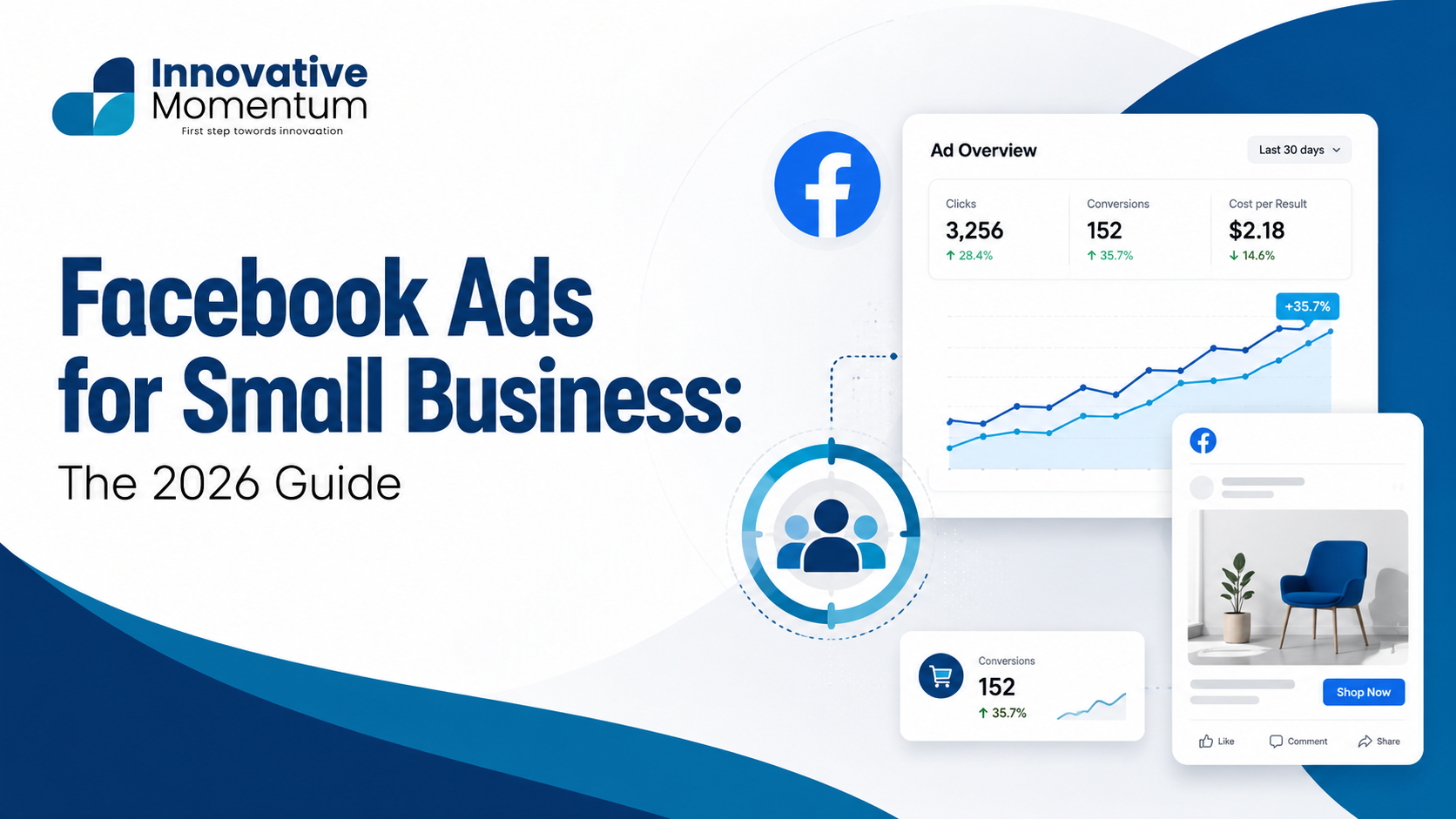
Key takeaway
Small businesses get the best Facebook Ads ROI by targeting warm audiences first (website visitors and email lists), using lead generation campaigns over traffic campaigns, and testing creative with a small daily budget before scaling.
Facebook Ads remain one of the most powerful paid advertising platforms for small businesses in 2026, combining unmatched audience targeting with a lower cost-per-click than Google Search for most industries. The platform gives you access to over 3 billion monthly active users across Facebook and Instagram, with targeting options that allow you to reach specific demographics, interests, behaviours, and custom audiences built from your own customer data. For small businesses with limited advertising budgets, Facebook Ads offer measurable lead generation when campaigns are set up and managed correctly.
This guide covers the Facebook Ads setup process, campaign structure, audience targeting, creative strategy, and measurement approach that small businesses need to run profitable campaigns in 2026.
Why Facebook Ads Still Work for Small Business in 2026
Despite competition from TikTok and the rise of AI search, Facebook and Instagram remain the dominant social advertising platforms for small businesses. Three reasons: audience scale (your local or niche audience is almost certainly on the platform), targeting precision (you can reach people by job title, income bracket, life events, and purchase behaviour), and the creative format variety (static images, video, carousels, Stories, Reels, and lead forms all in one auction). The businesses that get strong results from Facebook Ads in 2026 are those that treat creative quality as the primary lever — the targeting algorithm has become sophisticated enough that the audience will find itself if the creative and offer are strong.
Campaign Objectives: Choosing the Right One
Meta’s Advantage+ campaign architecture groups objectives into six categories. For small service businesses, the most relevant are:
Innovative Momentum
Want to implement these strategies for your business?
We help businesses grow with digital marketing, SEO, and AI-ready content strategies.
- Leads: Optimises for lead form completions or website form submissions. Best for service businesses collecting enquiries. Use Meta’s native lead forms for high-volume lead generation (lower friction than a website form); use website conversion campaigns when lead quality is more important than volume.
- Awareness: Optimises for reach and impressions. Use for brand-building in a local market before running conversion campaigns. Not suitable as a sole campaign type for small budgets.
- Traffic: Optimises for link clicks to your website. Useful for blog content distribution and remarketing setup, but does not optimise for conversions — do not use Traffic campaigns when you want leads.
- Sales: Optimises for purchase events. Required for e-commerce; uses the Meta Pixel purchase event as the optimisation target.
The most common small business mistake: running Traffic campaigns expecting leads. Always match the campaign objective to the business outcome you want. Our guide on digital marketing strategy for small businesses covers how paid social fits within the full channel mix alongside SEO and email marketing.
Audience Targeting: The Three Layers
Meta Ads targeting works in three layers, from cold to warm:
Cold audiences
People who have no prior relationship with your business. Target using: interest targeting (categories related to your service), behavioural targeting (people who have recently shown purchase intent in your category), demographic targeting (age, location, income, life events), and lookalike audiences (people who are statistically similar to your existing customers).
Warm audiences
People who have interacted with your content or visited your website. These are built from: website visitors (tracked via the Meta Pixel), video viewers (people who watched at least 25-50% of a video you ran), lead form openers (people who opened but did not complete a lead form), and Instagram/Facebook page engagers. Warm audiences convert at significantly higher rates than cold audiences and should have their own ad sets with messaging that acknowledges prior exposure.
Custom audiences from customer data
Upload your existing customer email list (minimum 1,000 emails for meaningful match rates) to create a Custom Audience. Use this for: excluding existing customers from acquisition campaigns, targeting existing customers with upsell or referral offers, and creating lookalike audiences based on your best customers rather than all website visitors.
Creative Strategy: What Actually Converts
Creative quality is the primary performance variable in Meta Ads in 2026. The platform’s algorithm is highly capable at finding the right audience for a strong creative — but it cannot compensate for weak creative. For small business Facebook Ads, the creative formats with the strongest conversion rates:
- Video testimonials: Real customer testimonials recorded on a phone, even without professional production, consistently outperform polished branded video for service businesses. Authenticity signals trust faster than production value.
- Problem-solution carousel: Slide 1 states a problem your target customer has, slides 2-4 show how you solve it, slide 5 has a CTA. The carousel format forces sequential engagement that builds context before asking for the conversion.
- Before/after results: Visual results (photography, project transformations, outcome metrics) drive high click-through rates for trades, fitness, home improvement, and similar sectors where the outcome is visually demonstrable.
- Offer-first static ads: A clear headline stating the offer (free consultation, fixed-price quote, guaranteed turnaround) with minimal design elements. These look native to the feed rather than like ads, reducing scroll-past behaviour.
Test a minimum of 3-5 creative variants per ad set. Meta’s algorithm needs creative variety to optimise — running a single creative denies the algorithm the data it needs to identify which message resonates with which segment.
Budget, Bidding and the Learning Phase
Facebook Ads run on an auction system where you bid for ad delivery to your target audience. For small businesses, Advantage Campaign Budget (ACB) — where Meta automatically distributes budget across ad sets based on performance — outperforms manual budget allocation for most campaigns. Set your campaign budget at a level that allows each ad set to receive at least 50 conversion events per week; below this threshold, the algorithm is in a perpetual learning phase and performance is inconsistent.
The learning phase is the first 1-2 weeks of a new campaign or after significant edits. During this phase Meta is gathering data on which users in your target audience are most likely to convert. Avoid making changes during the learning phase — each edit resets the learning counter. Minimum realistic budget to exit the learning phase for a lead generation campaign: £300-500 for the first two weeks. Campaigns with less budget take longer to exit learning and deliver less predictable results.
Meta Pixel: The Foundation of Tracking and Remarketing
The Meta Pixel is a snippet of JavaScript code placed on your website that tracks visitor behaviour and reports conversion events back to Meta. Without the Pixel, you cannot: track website conversions, run remarketing campaigns to website visitors, create lookalike audiences from website traffic, or optimise campaigns for website events. Installing the Pixel before running any campaigns is essential — campaigns run without Pixel data have no conversion signal to optimise against.
Install the Pixel via the Meta Events Manager in Business Manager. For WordPress sites, use the Meta Pixel plugin or Google Tag Manager (which also handles Google Analytics and other tags from a single interface). Set up standard events: PageView (fires on all pages), Lead (fires on form submission confirmation), and Purchase (fires on order confirmation for e-commerce). Our guide on B2B lead generation tactics covers how to align your website’s conversion events with your ad platform tracking for accurate attribution.
Lead Quality vs. Lead Volume
Meta’s native lead forms — forms that open within the Facebook app without requiring a website visit — generate significantly higher lead volume at lower cost-per-lead than website landing page forms. The trade-off: native lead form submissions are often lower quality because the friction is lower and the visitor does not need to visit your website to learn more before submitting. The auto-fill feature pre-populates contact fields from the user’s Facebook profile, which reduces effort to near-zero — and low-effort actions attract lower-intent submissions.
For service businesses where lead quality matters more than volume, website conversion campaigns (where the ad drives to a landing page) typically generate fewer but better-qualified leads. For high-volume service categories (insurance, financial advice, home improvement) where a follow-up call qualifies the lead anyway, native lead forms can be more cost-effective. Test both approaches with comparable spend before deciding which suits your sales process better.
Facebook Ads Campaign Checklist Before You Launch
Many small business Facebook ad campaigns fail not because the strategy is wrong but because critical setup steps were skipped. Before publishing any campaign, run through this checklist:
- Facebook Pixel installed and verified: The Pixel should be firing on all pages, with the Purchase or Lead conversion event confirming in Events Manager. A Pixel that is not tracking conversions makes automated bidding effectively blind.
- Ad account billing confirmed: A billing failure pauses all active campaigns. Confirm your payment method is valid and has sufficient credit limit for your daily budget.
- Business Manager ownership verified: Ads run from a Business Manager account (not a personal ad account) have stronger protections against account restriction and greater management flexibility.
- Campaign objective matches business goal: A Lead Generation objective optimises for form submissions; a Traffic objective optimises for clicks. Running a Traffic campaign when your goal is leads produces the wrong result regardless of how good the ad creative is.
- Ad creative tested at multiple aspect ratios: Facebook displays ads in multiple placements — Feed (1:1 or 4:5), Stories (9:16), and Right Column (1:1.91). Creative that is not optimised for each placement appears cropped or distorted in some placements, reducing performance.
- Landing page mobile-optimised: Most Facebook users access the platform on mobile. The landing page your ad links to should load in under 3 seconds on mobile and have a clear, mobile-friendly conversion action. Our guide on website speed optimisation covers the core performance improvements that protect mobile landing page conversion rates.
- Audience size appropriate for budget: A daily budget of £20 against an audience of 50 million people will never generate statistically meaningful data. Audience sizes of 100,000-500,000 for most UK small business campaigns produce actionable data at typical small business budgets.
Common Facebook Ads Mistakes Small Businesses Make
Understanding the mistakes most frequently made by small businesses in Facebook advertising helps avoid the budget-wasting patterns that cause many businesses to conclude “Facebook ads don’t work for us” before they have properly tested the channel.
The most common mistake is changing campaigns too quickly. Facebook’s algorithm needs time to learn — typically 50 conversions per ad set before it exits the learning phase. Changing targeting, budgets, or creative before the algorithm has had time to optimise generates unstable results and restarts the learning process. Patience for 7-14 days before making significant changes is required for meaningful performance data.
The second most common mistake is running a single ad creative without testing alternatives. Ad fatigue — declining performance as the same audience sees the same ad repeatedly — typically begins within 2-3 weeks for smaller audiences. Running 3-4 creative variants from launch extends effective campaign life and provides data on which messages and formats resonate most strongly with your audience. Creative refresh, not just bid changes, is the primary lever for sustained Facebook ad performance. Our guide on digital marketing strategy covers how Facebook advertising connects with your broader paid and organic growth plan.
Frequently Asked Questions
How much do Facebook Ads cost for small businesses?
Cost per result varies enormously by industry, audience, creative quality, and competition. In the UK, typical cost per lead for service businesses ranges from £8-50 depending on industry. Legal, financial, and medical services cost more due to competition. Trades and home services typically achieve lower CPLs. The only reliable way to know your actual CPL is to run campaigns with sufficient budget to exit the learning phase (minimum 50 conversion events) and measure results over 4-6 weeks.
How long before Facebook Ads generate results?
New campaigns typically require 2-4 weeks to exit the learning phase and deliver consistent results. Expect the first two weeks to produce variable performance while the algorithm optimises. Week 3-6 usually shows stabilised CPL and predictable delivery. Budget for at least 8 weeks before making strategic decisions about whether Facebook Ads are viable for your business.
Should I run Facebook Ads or Google Ads?
Google Search Ads capture existing demand (people actively searching for your service); Facebook Ads create demand by interrupting people who are not currently searching. For services with clear, frequent search intent (emergency plumber, local dentist), Google Ads typically outperform. For services with lower search volume or longer consideration cycles (financial planning, premium home renovation), Facebook Ads can build awareness and pipeline that Google Ads cannot. Most small businesses benefit from both channels at the appropriate budget allocation. Our guide on small business digital marketing strategy covers the channel allocation decision in detail.
Retargeting Campaigns: Your Highest-ROI Audience
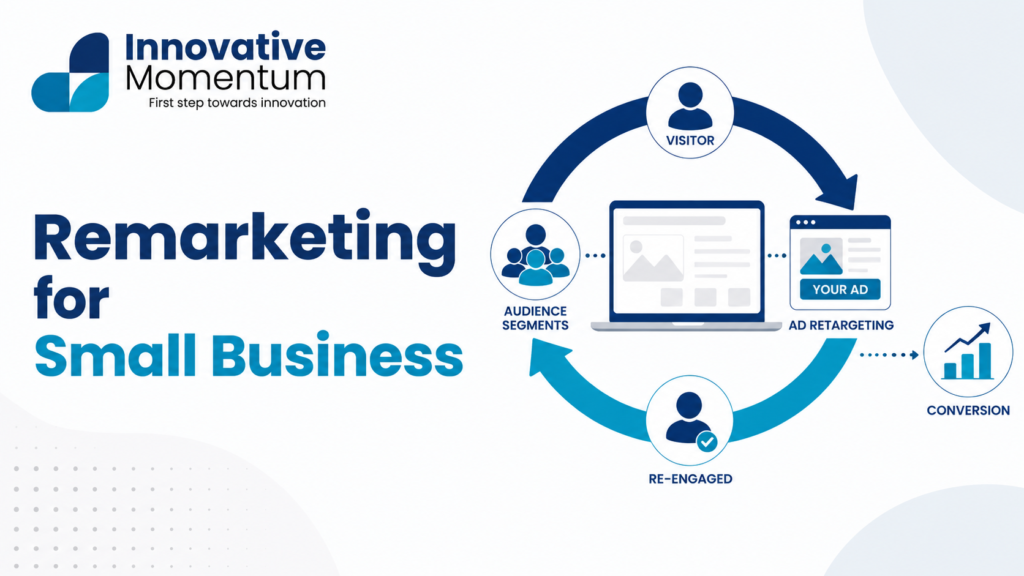
Website visitors who did not convert are the most valuable audience in your Meta Ads account because they have already expressed interest in your business. A retargeting campaign that shows ads to recent website visitors (7, 14, and 30-day windows) consistently achieves the lowest cost-per-lead of any audience type. The messaging for retargeting should be different from cold audience campaigns: rather than introducing your service, address the specific objection that prevented conversion — social proof (testimonials, case studies), risk reduction (guarantees, free consultations), or time-sensitive offers that create urgency.
Retargeting audience sizes are limited by website traffic volume. A site receiving fewer than 500 visitors per month will have a retargeting pool too small for effective campaign delivery. Build retargeting campaigns only after the Pixel has accumulated at least 1,000 matched website visitors, and use website traffic growth (via SEO and content marketing) as the foundation that makes retargeting viable at scale. For help setting up Facebook Ads campaigns for your business, contact Innovative Momentum.

Keep reading
Related insights
No comments yet. Be the first to share your thoughts.