
Key takeaway
The highest-ROI AI marketing tools for small businesses are AI writing assistants for content creation, AI SEO tools for keyword research, and AI chatbots for lead capture — most have free tiers good enough to start.
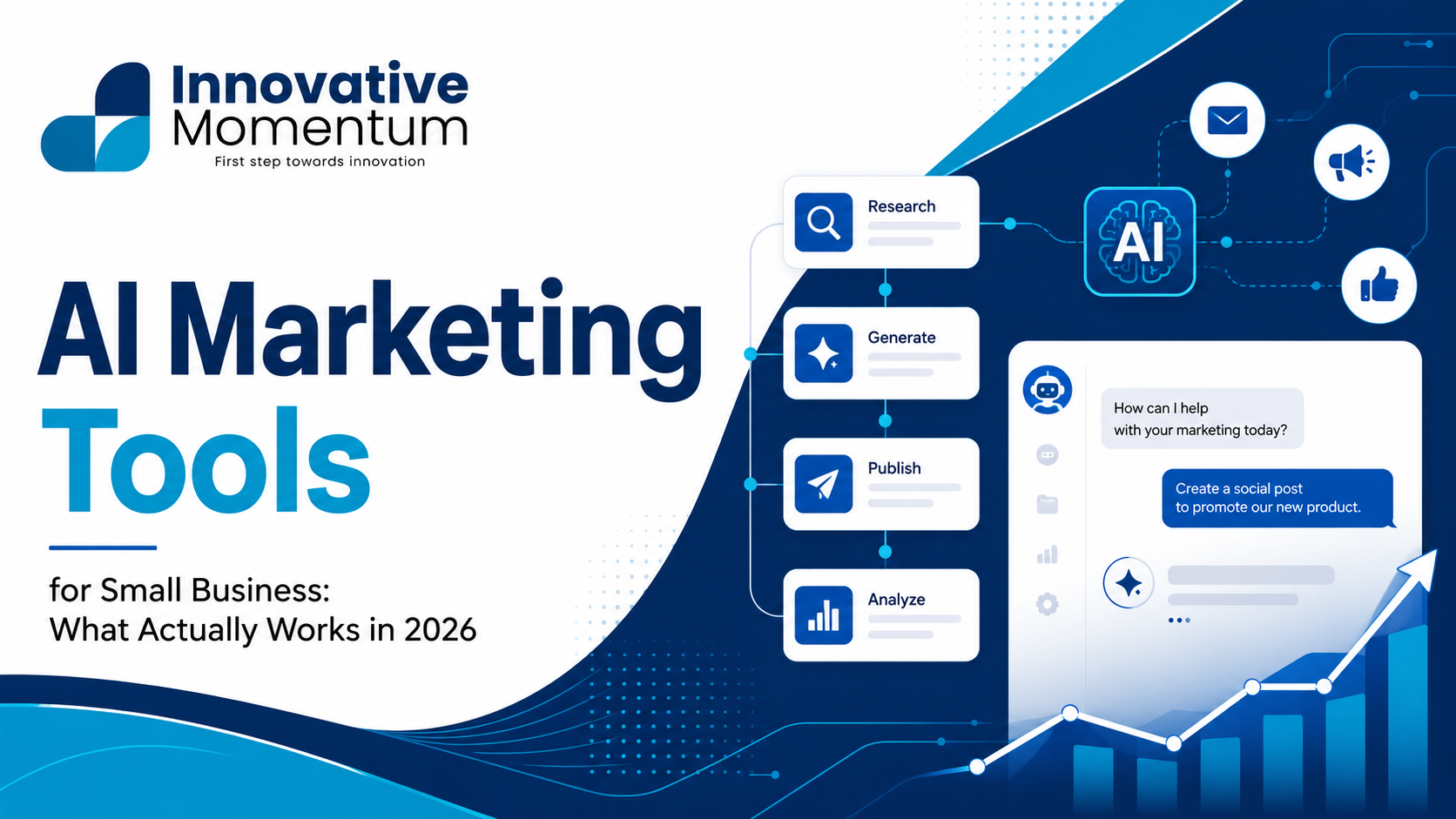
Artificial intelligence tools are reshaping every part of small business marketing in 2026. Content that took a week to research and write can now take hours. Customer questions can be answered automatically 24 hours a day. Audience segments can be identified from behavioral data without manual analysis. The small businesses that use these tools effectively are not necessarily spending more on marketing — they are accomplishing more with the same resources, at faster cycles, than competitors who have not adopted AI yet.
This guide covers the AI marketing tools most relevant to small businesses in 2026, how they fit into existing workflows, and the realistic constraints to understand before investing time and budget in any AI tool.
The AI Marketing Landscape for Small Businesses
AI marketing tools in 2026 fall into several categories: content creation tools, AI search optimization tools, CRM and automation tools, image generation, and analytics and prediction tools. They vary enormously in quality, cost, and practical applicability for small businesses. The most effective small business AI adopters use 3-5 focused tools deeply rather than experimenting superficially with dozens.
The fundamental shift AI tools enable: they handle the mechanically repeatable parts of marketing work — first drafts, formatting, scheduling, data processing — freeing time for the higher-value activities where human judgment, relationships, and genuine expertise create results that AI cannot replicate. Clients choose your business because they trust you; the blog post that earns that trust still needs your experience and perspective at its core, regardless of which tools assist in writing it.
Innovative Momentum
Want to implement these strategies for your business?
We help businesses grow with digital marketing, SEO, and AI-ready content strategies.
AI Content Creation Tools
Content creation is where AI provides the most immediate, measurable time savings for small business marketers. AI writing tools are useful for:
- First drafts: Generating a structured draft from an outline, key points, or source material. The draft requires editing for accuracy, brand voice, and the experience-based insights that AI does not have — but the blank-page problem is eliminated.
- Content repurposing: Converting a long blog post into a LinkedIn post, email newsletter, and a short social caption. This multi-format content distribution from a single source takes minutes with AI tools rather than hours manually.
- Meta description and title generation: Writing optimized SEO titles and meta descriptions for existing pages is tedious; AI produces good candidates quickly that can be reviewed and refined.
- Email subject line testing: AI tools can generate 10-20 subject line variants from a single brief, accelerating the testing process.
Current AI content tools worth evaluating: Claude (Anthropic), ChatGPT (OpenAI), and Gemini (Google). For SEO-specific content workflows, Surfer SEO and MarketMuse integrate keyword data directly into the writing interface, scoring content against top-ranking competitors in real time.
AI content has a critical limitation: it lacks genuine experience. Google’s E-E-A-T framework (covered in our guide on E-E-A-T for small businesses) explicitly evaluates Experience as a quality signal — does this content demonstrate first-hand knowledge? AI-generated content that does not incorporate genuine expertise cannot demonstrate experience, which limits its ability to compete for competitive queries where E-E-A-T is weighted heavily.
AI for SEO and Generative Engine Optimization
AI is changing not just how SEO content is created but how it is discovered. AI-powered search engines — ChatGPT, Perplexity, Google’s AI Overviews, Microsoft Copilot — draw directly from web content to answer queries. Small businesses that optimize for these AI search surfaces can reach new audiences without relying solely on traditional search rankings.
Generative Engine Optimization (GEO) is the practice of optimizing content to be cited by AI answer engines. Our guide on GEO for small businesses covers the specific optimization strategies that increase the likelihood of your content being referenced in AI-generated answers. Our companion guide on how to get cited in ChatGPT and AI search covers the practical implementation steps for appearing in AI search results.
For traditional SEO, AI tools now assist with keyword research (identifying semantic relationships between topics), technical SEO audits (automated crawl analysis with AI-generated recommendations), and competitor analysis. Tools like Semrush, Ahrefs, and Moz have integrated AI features into their existing platforms — these are often more practical for small business SEO than standalone AI tools because they combine AI with real search data.
AI for Social Media Marketing
Social media content calendars are one of the highest time-cost activities in small business marketing. AI tools can generate content ideas, write post variations, suggest optimal posting times based on historical engagement data, and repurpose long-form content into social formats. The practical workflow:
- Create one long-form piece (blog post, case study, video) per week
- Use AI to generate 5-7 social posts from that single piece in different formats (key insight, data point, question to audience, behind-the-scenes angle)
- Review and edit for authenticity and brand voice
- Schedule via Buffer, Hootsuite, or Meta Business Suite
This workflow produces a week’s worth of social content from one source piece in under an hour — versus 3-4 hours if writing each post independently. Tools specifically designed for this: Taplio (LinkedIn content), Publer, and Buffer’s AI Assistant.
AI Chatbots and Website Automation
AI-powered website chatbots handle the routine enquiries that occupy significant time for small service businesses: “What areas do you serve?”, “How much does it cost?”, “Are you available on weekends?”, “How do I get a quote?”. A well-configured chatbot qualifies visitors, collects contact information, and answers FAQs 24/7 — extending your availability without extending your working hours.
For small businesses, the most practical implementation: a rules-based chatbot with AI-assisted responses handling defined FAQ categories, with a handoff to email or a form for complex enquiries. Tools like Tidio, Crisp, and Intercom offer small business pricing with AI features. A chatbot is not a replacement for real human interaction in the sales process — it is a triage tool that identifies which enquiries are worth your time and collects the information needed to respond efficiently.
AI for Email Marketing
AI email marketing tools provide: subject line optimization (suggesting variants predicted to improve open rate), send time optimization (sending each email at the time each subscriber is most likely to open based on historical data), personalization at scale (inserting dynamic content based on subscriber behavior), and churn prediction (identifying subscribers whose engagement is declining before they unsubscribe). HubSpot, Mailchimp, and ActiveCampaign have all integrated AI features into their platforms that handle most of these automatically once the initial configuration is done.
For the overall email marketing strategy that AI tools sit within, our guide on content marketing for small businesses covers the content-first approach that makes AI email tools effective rather than just automating empty content.
AI Image Generation
AI image generation tools (Midjourney, DALL-E 3, Adobe Firefly, Stable Diffusion) can generate custom imagery for blog posts, social media, and email campaigns without stock photography costs. For small businesses, the practical applications: custom illustrations for blog posts that cannot be satisfied by stock photography, branded social media graphics from text prompts, and product visualization. Current limitations: AI-generated images of people often require careful review for realism, and legally complex for commercial use in some jurisdictions — check the usage terms of each tool.
Limitations and Realistic Expectations
AI tools consistently underperform in: generating genuine insights from direct experience (they summarize existing knowledge, not new knowledge), building personal relationships that create client trust, producing creative work with true originality, and making strategic judgments that require understanding of your specific business context and relationships.
The risk of over-relying on AI tools: homogenization. If every small business in a market uses similar AI tools with similar prompts, their content converges — and differentiation, which is one of the most valuable things marketing can create, disappears. Use AI tools to handle repetitive production work; invest your human time in the thinking, positioning, and relationship-building that creates genuine competitive advantage.
For a digital marketing strategy that uses AI tools appropriately, our guide on small business digital marketing strategy covers the full channel mix. For help implementing AI-assisted marketing workflows for your business, contact Innovative Momentum.
Frequently Asked Questions
Will AI replace the need for a marketing agency or freelancer?
AI tools reduce the time required for production work (writing, graphic design, basic analysis), but they do not replace strategy, relationship management, or deep expertise. An experienced marketing professional using AI tools delivers better results faster than either alone. For small businesses, AI tools make it possible to do more in-house — but the judgment about what to create, for whom, and how to position it still benefits from external expertise, particularly for businesses in competitive markets.
Are AI-generated blog posts penalized by Google?
Google’s position is that it evaluates content quality regardless of how it was produced — the distinction is between helpful, original content and low-quality, auto-generated spam. Well-edited AI-assisted content that incorporates genuine expertise and provides real value to readers is not penalized. Thin, formulaic AI content generated at scale without meaningful human oversight is what Google targets. The practical standard: would this content satisfy a knowledgeable reader seeking help, or does it read like a verbatim training data summary?
How much should a small business spend on AI marketing tools?
Most category-leading AI tools for small business marketing have free tiers or low-cost plans that cover initial needs. Realistic spending for a full AI-assisted marketing stack: £50-150/month across content writing (Claude or ChatGPT Plus), SEO tools (Ahrefs or Semrush starter), and social scheduling (Buffer Pro or Hootsuite). Compare this to the cost of the equivalent human time these tools replace — the ROI is typically strong within the first month of consistent use.
AI for Customer Research and Audience Intelligence
Understanding your customers — their language, their specific objections, the questions they ask before buying — is one of the most valuable inputs to marketing strategy. AI tools accelerate customer research in several ways. Claude, ChatGPT, and Perplexity can synthesize patterns from publicly available reviews, forum discussions, and social media conversations about your service category — quickly surfacing the recurring concerns and questions your target audience expresses before making a buying decision.
Practical AI customer research workflow: feed your existing customer testimonials and reviews into an AI tool and ask it to identify recurring themes, common outcomes mentioned, and language patterns. The resulting analysis — which would take hours to extract manually — provides the vocabulary your customers use to describe their problems and your solutions. Using this language in your website copy, ad headlines, and content headlines creates immediate resonance with new visitors who recognize their own situation being described accurately. Our guide on E-E-A-T for small businesses covers how genuine customer understanding expressed in your content contributes to Google’s assessment of your expertise and authority.
Prompt Engineering for Marketing Tasks
The quality of AI output is directly determined by the quality of the instructions you provide. Small businesses that get consistently useful output from AI marketing tools invest time in developing reusable prompts — templates that reliably produce the format and quality needed for each specific marketing task.
Effective marketing prompt principles:
- Specify the role: “You are a B2B marketing copywriter specializing in professional services” produces more appropriate tone and framing than a generic prompt.
- Provide context: Include your business type, target audience, and tone guidelines. “Our audience is SME business owners aged 35-55 who are skeptical of marketing agencies and value plain-English explanations” changes the output significantly compared to no audience specification.
- Specify the format: “Write a 150-word LinkedIn post with no hashtags, one hook line, three key points, and a question at the end” produces better formatted output than “write a LinkedIn post.”
- Provide examples: Including examples of content that matches your desired style trains the AI model on your specific voice for that session. “Here is an example of a blog post introduction that matches our tone: for example. Write the introduction for a new post about your topic in the same style.”
Invest 30 minutes developing a prompt library for your 5-10 most recurring marketing tasks. Stored in a simple document, these prompts dramatically reduce the time from blank screen to usable first draft. For the broader digital marketing strategy that AI tools support, our guide on small business digital marketing strategy covers how to prioritize marketing activities and channel investment at different business growth stages. For help implementing AI-assisted marketing systems, contact Innovative Momentum.

Keep reading
Related insights
No comments yet. Be the first to share your thoughts.